

If you’ve ever tried doing SEO keyword research and ended up with a messy spreadsheet of hundreds of keywords, you already understand the problem keyword clustering solves. You find “best running shoes,” “best shoes for running,” “top running shoes,” “running shoes for beginners,” and dozens more. They look different, but they might represent the same search intent. Or they might be different enough that they deserve separate pages. The question is: how do you know?
That’s where AI keyword clustering comes in.
So, what is AI keyword clustering in simple words? It’s the process of using AI tools to automatically group related keywords into clusters based on meaning and search intent. Instead of treating every keyword as its own target, keyword clustering helps you organize keywords into topic groups so you can create the right pages, avoid cannibalization, and build stronger topical coverage.
This article is a simple explanation for beginners. You’ll learn what AI keyword clustering for SEO is, how it works at a practical level, how to use it for content planning, and the common mistakes to avoid. The goal is to help you understand the concept without jargon and use it in a way that improves your SEO strategy.
What Is Keyword Clustering?
Keyword clustering, even without AI, is basically organizing keywords into groups that belong together. The point is not to make your spreadsheet look nice. The point is to make better SEO decisions.
When you cluster keywords properly, you can answer questions like:
Should these keywords be targeted on one page or multiple pages? Which keyword should be the main focus keyword for the page? What subtopics should the page include to fully satisfy search intent? How do I plan content so my site covers the topic deeply?
Without clustering, beginners often create too many pages that overlap, or they create one giant page that tries to rank for everything. Both approaches usually lead to weak results.
Clustering makes SEO more strategic. It helps you build pages around topics and intent, not just around individual phrases.
What Is AI Keyword Clustering?
Now let’s add AI.
AI keyword clustering uses artificial intelligence to group keywords automatically. Instead of manually deciding which keywords belong together, AI tools analyze keywords and cluster them based on semantic similarity, intent signals, and sometimes search engine result patterns.
The reason AI is useful here is scale. Manual clustering works when you have 30 or 50 keywords. It becomes painful at 500 or 5,000. AI can process large keyword sets quickly and provide a structured set of clusters you can use to plan content.
This is why the phrase “what is AI keyword clustering” is showing up more often in beginner SEO discussions. It takes an annoying, error-prone task and makes it faster and more consistent.
Why AI Keyword Clustering for SEO Matters
Keyword clustering matters because Google doesn’t rank keywords in isolation. It ranks pages that best satisfy intent. A single page can rank for many related queries if it covers the topic properly. That’s why you’ll often see one strong article ranking for hundreds of keyword variations.
AI keyword clustering helps you build pages that match this reality. Instead of writing separate pages for every variation, you cluster them and create one stronger page that targets the main intent and naturally includes related subtopics.
Clustering also helps prevent keyword cannibalization, which happens when multiple pages on your site compete for the same keyword intent. Cannibalization confuses search engines and often results in unstable rankings. Clustering helps you decide where each keyword belongs so your pages support each other instead of fighting.
Finally, clustering helps with topical authority. When you cluster keywords, you can map your content in a way that builds a coherent topic library. Over time, this improves your site’s overall relevance and can make ranking easier.
How AI Keyword Clustering Works
You don’t need to understand machine learning to use AI keyword clustering, but it helps to know what the tool is looking at.
Most AI clustering tools use some combination of:
Semantic similarity: Does the keyword mean something similar to another keyword? For example, “budget laptops” and “cheap laptops” are semantically similar.
Intent similarity: Are people searching these keywords trying to accomplish the same thing? “Best budget laptops” and “cheap laptops under $500” likely share a buying intent.
SERP similarity (in some tools): Do the search results pages look similar for the two keywords? If Google shows very similar top results for two keywords, they’re often the same intent and can be targeted on one page.
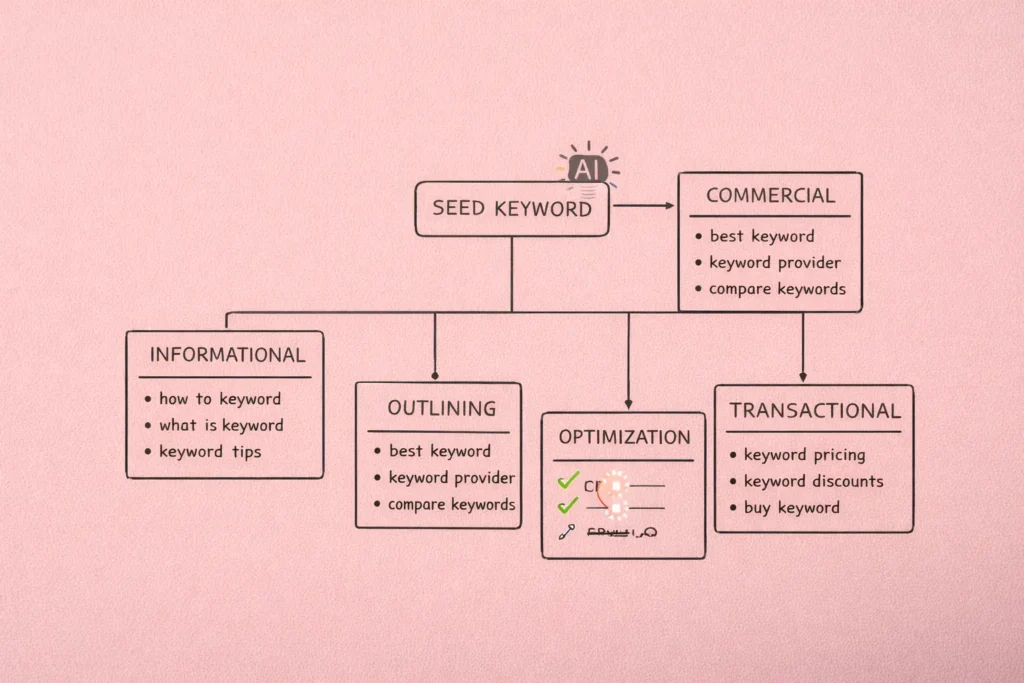
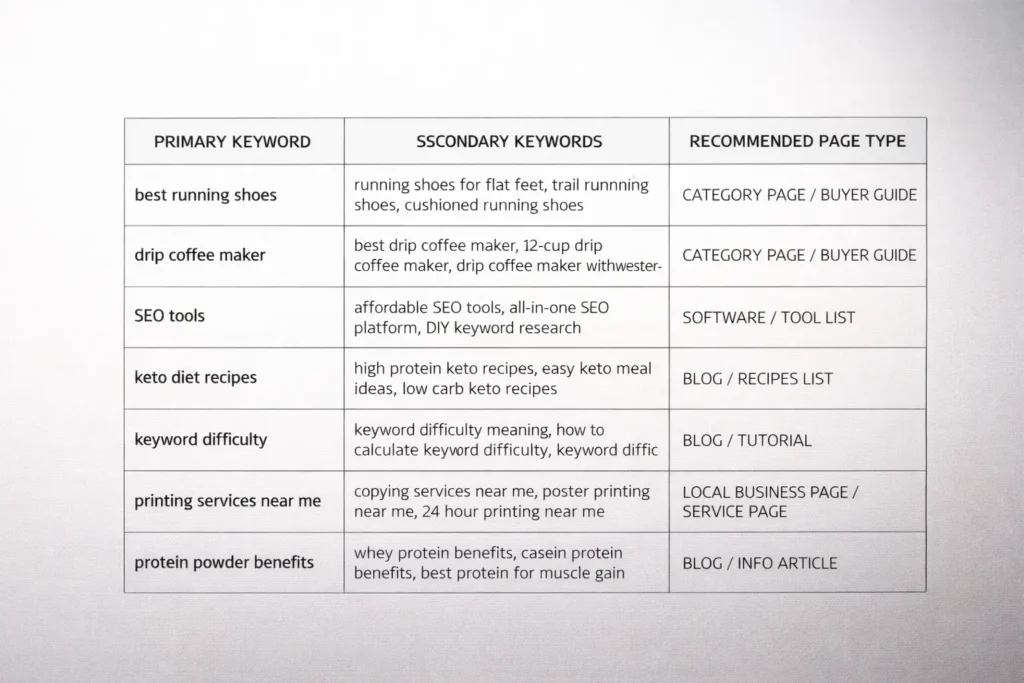
AI tools use these signals to group keywords into clusters. Each cluster usually has a “primary keyword” (the main target) and “secondary keywords” (variations and supporting terms). Your content then targets the cluster rather than a single phrase.
The output is not magic truth. It’s a starting point. You still need to review clusters and make editorial decisions, especially when the topic is nuanced.
Keyword Clusters vs Keyword Lists: What Changes in Your Content Strategy
A keyword list is a collection of phrases. A keyword cluster is a content plan.
When you work from a list, you might write random articles because each keyword looks like a separate opportunity. This can lead to overlap, thin content, and unclear site structure.
When you work from clusters, your strategy changes. You start planning pages around intent groups. You decide what your pillar pages are and what your supporting pages are. You build internal links naturally. You avoid writing duplicate content. And you often produce fewer pages, but stronger ones.
That’s why AI keyword clustering is so powerful for beginners. It turns keyword research into something actionable. It gives you a roadmap.
Practical Examples of Keyword Clustering
Let’s take a simple example. Imagine you run a blog about home coffee.
You might collect keywords like: “best coffee grinder,” “coffee grinder for espresso,” “burr grinder vs blade,” “cheap coffee grinder,” “best grinder for French press,” and so on.
Without clustering, you might write separate posts for each phrase. But that can create overlap. With clustering, you might realize that “best coffee grinder,” “coffee grinder for espresso,” and “best grinder for French press” could belong in a broader buying guide cluster—or they could be separate clusters if the intent is different enough.
AI keyword clustering helps you make that decision faster by grouping phrases that likely share intent. Then you review. You might decide you want one broad “best coffee grinders” guide, plus separate pages for “espresso grinder” and “French press grinder” if the search results suggest distinct intent.
This is the human layer that matters: AI clusters suggest patterns; you decide the final content structure.
When Clustering Helps Most
Clustering is most valuable when you have many keywords and you want to build a structured content plan. It’s especially helpful for content sites, niche blogs, e-commerce categories, and service websites that want to create multiple location/service pages without duplication.
Clustering is also helpful when you want to update existing content. If you have old articles that overlap, clustering can reveal where consolidation makes sense. Sometimes combining two weak pages into one strong page improves rankings.
Clustering is less important when your site has very few pages or when you are targeting a single highly specific keyword. But as soon as you start building content consistently, clustering becomes a major advantage.
How to Use AI Keyword Clustering for Content Planning
You asked for paragraph-heavy writing with minimal lists, so I’ll keep this simple.
First, collect your keyword ideas. Use your keyword research tool, competitor research, or Google suggestions. Export them into a list.
Second, run them through an AI keyword clustering tool. The output will typically be clusters with a primary keyword and related keywords.
Third, review clusters manually. Look for clusters that are too broad or too mixed. If something feels wrong, it probably is. AI can mis-group keywords when intent is subtle.
Fourth, assign each cluster to a content asset: a blog post, category page, landing page, or FAQ page. Decide what your pillar pages are and what your supporting pages are. This is where strategy happens.
Fifth, write content that targets the cluster. Use the primary keyword in the title and naturally incorporate secondary keywords in headings and paragraphs where relevant. Avoid forcing them.
Finally, interlink pages between related clusters. Clustering naturally reveals internal linking opportunities.
This workflow is a practical way to answer what is AI keyword clustering: it’s not just grouping for organization—it’s grouping to decide what to build.
One Page or Multiple Pages?
The most valuable outcome of clustering is not the clusters themselves. It’s the decisions you make from them. The biggest decision is this: should a cluster become one page, or should it be split into separate pages?
A beginner-friendly way to decide is to think in terms of intent. If two keywords represent the same intent, they usually belong on one page. If they represent different intents, they usually deserve separate pages.
For example, “best budget laptops” and “cheap laptops under $500” are typically the same intent: someone wants affordable laptop recommendations. Those belong together. But “laptop won’t turn on” is a troubleshooting intent, and it doesn’t belong on the same page as a buying guide.
AI keyword clustering helps by grouping keywords that likely share intent, but you should still sanity-check clusters. The most reliable check is the search results themselves. If you search two keywords and the top results are very similar, that’s a strong sign they belong on one page. If the results are different types of pages, that’s a sign you should split.
This is a simple but powerful reason AI keyword clustering matters: it prevents you from creating content that competes with itself or content that tries to satisfy multiple intents at once.
How AI Keyword Clustering Helps Prevent Keyword Cannibalization
Keyword cannibalization happens when multiple pages on your site target the same intent. Beginners often cause this accidentally. They see keyword variations and assume each one needs its own article. Over time, they end up with three posts that overlap heavily, and none of them rank consistently.
AI keyword clustering reduces this risk by grouping variations into a single cluster. That cluster becomes one content asset. Instead of writing “best running shoes,” “top running shoes,” and “running shoes best for beginners” as separate pages, you might create one strong guide that covers the topic thoroughly and uses subheadings to address the variations.
Cannibalization doesn’t always mean you should delete content, but it often means you should consolidate or differentiate. Clustering helps you identify overlaps early, before you waste time creating competing pages.
When you’re managing a growing site, this is a huge advantage because it’s easy to lose track of what you’ve already published. A cluster-based plan keeps your content organized and intentional.
Turning Keyword Clusters Into a Simple Site Structure
A good site structure isn’t complicated. It’s logical. Clustering naturally leads to a structure where broad topics link to narrower topics, and related topics support each other.
Think of it like a library. You have major shelves (pillar topics), and then you have books within those shelves (supporting topics). Keyword clusters help you label the shelves and decide which books belong where.
A pillar page usually targets a broad cluster. Supporting pages target smaller, more specific clusters. Internal links connect them naturally.
For example, if your pillar topic is “AI SEO Tools,” you might have supporting pages for “AI keyword clustering,” “AI content optimization,” and “AI technical SEO basics.” Each supports the overall topic and builds depth. This kind of structure helps users explore and helps search engines understand your topical coverage.
The key beginner benefit is clarity. You stop publishing random articles and start building a connected content system.
AI Keyword Clustering vs Manual Clustering: What’s the Real Difference?
Manual clustering is possible, but it gets hard quickly. When you have hundreds or thousands of keywords, manual grouping becomes inconsistent. You might group by superficial similarity rather than by intent. You might miss overlaps. You might over-split topics or under-split them.
AI keyword clustering is faster and more scalable. It can detect semantic relationships more consistently, and many tools can incorporate SERP similarity for stronger intent-based clustering. That makes the clusters more actionable.
However, manual review is still essential. AI can misinterpret niche terms, brand terms, or ambiguous keywords. It can also group keywords together that look similar but represent different intents. That’s why the best approach is AI first, human review second.
A simple mental model is: AI gives you the first draft of your content map. You finalize it.
The Biggest Mistakes Beginners Make With AI Keyword Clustering
Clustering is powerful, but beginners can misuse it. Avoiding these mistakes will save you time and protect your SEO.
One common mistake is treating clusters as perfect. AI clustering is a model, not a guarantee. Always review clusters with your own understanding and quick SERP checks for high-stakes keywords.
Another mistake is overstuffing one page with too many intents. Some clusters become too broad. Beginners may try to cover everything in one massive article, but that can dilute focus. If a cluster includes keywords that clearly point to different “jobs,” split them into separate pages.
Another mistake is creating clusters but not using them. Some people run clustering, admire the output, and then go back to writing randomly. The real value comes when clusters become your editorial plan and your site structure.
Another mistake is ignoring internal linking. Clustering naturally reveals how topics relate, but if you don’t link between related pages, you lose a major SEO advantage.
Finally, beginners sometimes optimize too aggressively. They try to insert every keyword from the cluster into the page unnaturally. That hurts readability. The right approach is to write naturally and cover the subtopics properly. Keywords should appear because the topic requires them, not because you’re forcing them in.
How to Use AI Keyword Clustering for E-Commerce and Service Websites
Keyword clustering isn’t only for blogs. It’s extremely useful for e-commerce and service businesses too.
For e-commerce, clustering helps you organize category pages and collections. Instead of creating multiple thin category pages for small variations, clustering helps you decide what should be a category page, what should be a filter, and what should be a blog post supporting the category. It also helps avoid duplicate category pages that confuse search engines.
For service businesses, clustering helps you plan service pages and supporting content. You can cluster keywords around services, locations, and problems. Then you build pages that match intent—without creating dozens of near-identical pages that offer little unique value.
In both cases, clustering is a planning tool. It helps you decide what content assets are actually needed.
A Simple Quality Check: How to Validate a Cluster Quickly
You don’t need advanced tools to validate clusters. A quick validation method is to look at three things:
First, scan the keywords in the cluster and ask: do they sound like the same question? If yes, one page may work. If no, split.
Second, search the top two or three keywords in the cluster and compare results. If the same types of pages show up, the intent is likely aligned. If the results differ, the intent is likely different.
Third, consider the user journey. Some keywords are “beginner info,” some are “comparison,” and some are “buy.” If the cluster mixes these heavily, separate pages may work better.
This quality check keeps you from blindly trusting the tool.
Closing Thought
If you’re new to SEO, keyword lists can feel overwhelming. Clustering turns that chaos into a plan. That’s the real value behind what is AI keyword clustering: it organizes your keyword research around intent so you build fewer, stronger pages that work together.
Frequently Asked Questions
AI keyword clustering is using AI tools to group related keywords into clusters based on meaning and search intent. Instead of targeting each keyword separately, you target a cluster with one strong page that covers the topic thoroughly.
Because it helps you create better content plans, avoid keyword cannibalization, and build stronger topical coverage. It also helps your pages rank for multiple related queries by matching intent, not just a single keyword phrase.
Check search intent. If keywords share the same intent, one page usually works. If they represent different intents, split them into separate pages. A quick SERP check is often the best validation method.
No. Keyword research finds opportunities; clustering organizes them into a usable plan. You still need keyword research to collect keyword ideas and understand demand, but clustering helps you turn that research into content structure.
Yes. AI can mis-group keywords when intent is subtle or when keywords are ambiguous. That’s why human review matters. Treat clusters as a strong starting point, not an unquestionable answer.
Manual clustering is slow and inconsistent at scale. AI clustering is faster and more consistent for large keyword sets, especially when tools consider semantic similarity and SERP similarity. The best approach is AI clustering plus human review.
Yes, because it helps you build a clear content roadmap and avoid publishing overlapping pages. A structured topic plan is especially helpful for new sites trying to grow topical relevance.
Absolutely. Clustering helps e-commerce sites organize categories, avoid duplicate pages, and decide whether certain keyword groups need category pages, blog content, or filters. It improves clarity for both search engines and users.

Zaid Akhtar specializes in traffic tools, lead generation systems, and online business programs. He evaluates offers based on long-term usefulness, learning curve, and value for money, not just flashy features.