
Have you ever stared at a homework question for 20 minutes and still had no idea how to start?
That moment is common. The topic may feel hard, the wording may feel confusing, or the homework may cover something you missed in class. Many students don’t need a full answer. They need a clear explanation and a starting point.
This is where an AI homework helper comes in. An AI homework helper is a tool that helps students understand homework, break down questions, and study better. The best tools don’t just give answers. They explain steps, show examples, and help students learn the process.
This guide explains what an AI homework helper is, how it works, when it helps, and where students should be careful. If you want to use these tools the right way, this article will give you a practical foundation.
What an AI Homework Helper Means
An AI homework helper is a digital study tool that uses artificial intelligence to support students with homework tasks. Students can ask questions, paste a problem, or describe a topic they don’t understand. The tool then gives an explanation, summary, or step-by-step response.
The main purpose is support, not replacement. A good AI homework helper acts more like a study assistant than a shortcut. It helps students understand the work, organize ideas, and practice better.
These tools can help with many subjects, including math, science, history, language, and business studies. Some tools focus on writing support. Others focus on solving problems and explaining concepts.
Students often use AI homework helpers when:
- a textbook explanation feels too hard
- homework instructions feel unclear
- they need examples before solving a question
- they want a quick review before submitting work
The tool becomes most useful when the student asks clear questions. Better input usually leads to better explanations.
How an AI Homework Helper Works in Real Study Situations
AI homework tools work by reading the student’s question and generating a response based on patterns in language and information. In simple terms, the tool tries to understand what the student is asking and then gives a relevant explanation.
For example, a student might type:
- “Explain photosynthesis in simple words”
- “How do I solve this algebra equation step by step?”
- “Summarize this paragraph for class 8 level”
- “Help me make an outline for my history assignment”
The AI homework helper then responds in the requested format. It may explain a concept, solve a sample problem, rewrite text, or create a study plan.
Common input styles students use
Students usually interact with these tools in three simple ways:
Direct questions
Students ask a homework question just like they would ask a tutor.
Pasted text
Students paste notes, homework instructions, or a paragraph from a chapter and ask for a simpler explanation.
Task-based prompts
Students ask for a specific output, such as a summary, quiz, or outline.
Why this feels useful to students
The biggest reason students like these tools is speed. A student can ask a question at any time without waiting for class, tuition, or office hours. AI tools also allow follow-up questions, which helps when the first explanation doesn’t make sense.
That said, students still need judgment. A fast answer is not always a correct answer. The tool is most useful when students treat it like a guide and verify important details.
What an AI Homework Helper Can Help With
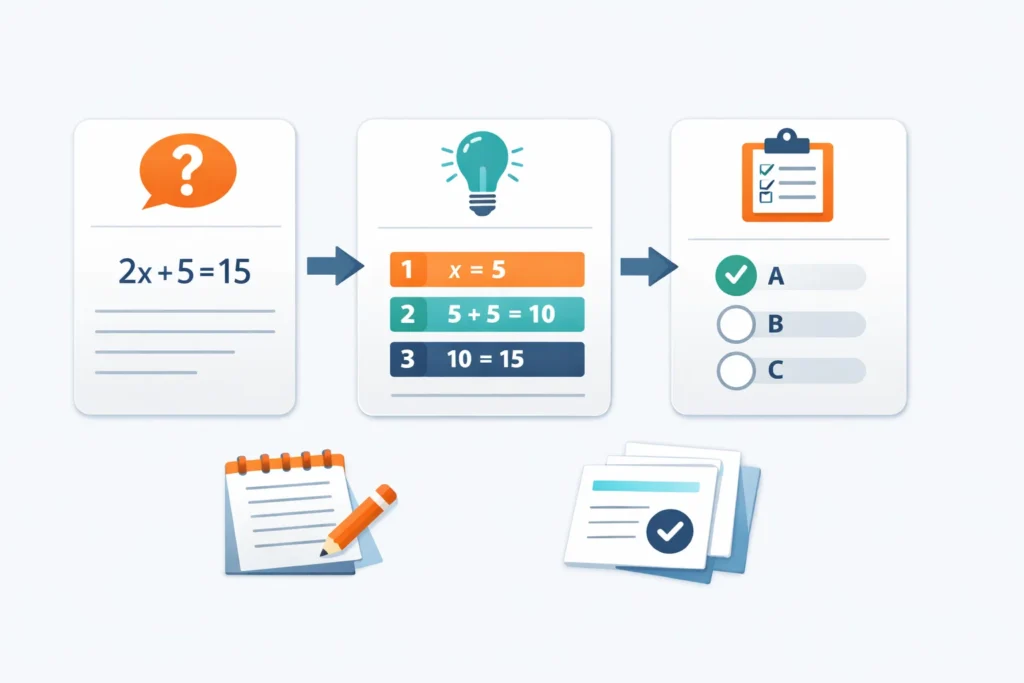
An AI homework helper can support many parts of the study process, not just final answers. Students often get the best results when they use the tool for understanding, planning, and practice.
Explaining difficult concepts
This is the most common use. Students ask AI to explain a topic in simpler words. They may also ask for examples or a step-by-step version.
This helps when class notes feel too short or textbook language feels too advanced.
Breaking down homework questions
Some homework questions look hard because the wording is confusing. AI can rewrite the question in plain English and show what the teacher is asking.
That small step often reduces stress and helps students start on their own.
Summarizing notes and chapters
Students can paste notes and ask for a short summary. They can also request bullet points, revision notes, or key definitions.
This is especially useful before tests or when notes are messy.
Writing support
AI homework helpers can help students:
- build outlines
- improve sentence clarity
- fix grammar
- rephrase awkward lines
- organize ideas into sections
This helps students write better, especially if they know the topic but struggle with wording.
Practice questions and revision
Students can ask AI to create quizzes, flashcards, or short-answer questions from their notes. This turns passive reading into active recall practice, which is better for memory.
A student can also ask for mixed-difficulty questions to prepare for exams more effectively.
Benefits of Using an AI Homework Helper
AI homework tools are popular for a reason. When used well, they solve common student problems without making study feel heavier.
Faster understanding
Students don’t stay stuck as long. Instead of staring at a question, they can ask for a simpler explanation and keep moving. This helps maintain momentum during study sessions.
Better organization
Homework often feels stressful because tasks pile up. AI can help students break large tasks into smaller steps, create study checklists, and plan what to do first.
That makes work feel more manageable.
More confidence to ask questions
Some students hesitate to ask “basic” questions in class. AI tools remove that pressure. Students can ask the same question three times in three different ways until the topic makes sense.
That privacy helps many students learn with less fear.
Support across subjects
A student may need help with math in the afternoon and essay writing at night. AI homework helpers can support multiple subjects in one place, which makes the workflow easier.
Useful for revision
Before exams, students can use AI to summarize notes, generate questions, and review weak topics. This makes revision more active and less repetitive.
The biggest benefit is not speed alone. The real benefit is reducing confusion so students can focus on learning.
Limits and Risks Students Should Understand
AI homework helpers are useful, but they are not perfect. Students need to understand the limits so they don’t build bad habits.
AI can make mistakes
An AI tool may give a wrong explanation, incorrect fact, or weak solution. Sometimes the answer sounds confident even when the details are wrong.
That’s why students should check important facts with class notes, textbooks, or trusted sources.
Weak learning from copy-paste use
If a student copies the answer and submits it, learning drops. The student may finish homework faster but still struggle in exams.
Homework is practice. If AI replaces practice, the student loses the real benefit.
Course-specific requirements may be missed
Teachers often want a specific format, method, or terminology. AI may explain a concept correctly but not in the way the teacher expects.
Students should always align the final answer with class instructions and grading criteria.
Overdependence can grow quickly
Once students get used to instant help, they may stop trying on their own. That habit can hurt problem-solving skills.
A better approach is to try first, then use AI for support where needed.
Privacy concerns
Students should avoid sharing sensitive personal information, private school details, or confidential documents in public AI tools. It’s better to keep prompts focused on the task itself.
AI homework helpers work best when students stay active and careful, not passive and trusting.
How to Use an AI Homework Helper Responsibly
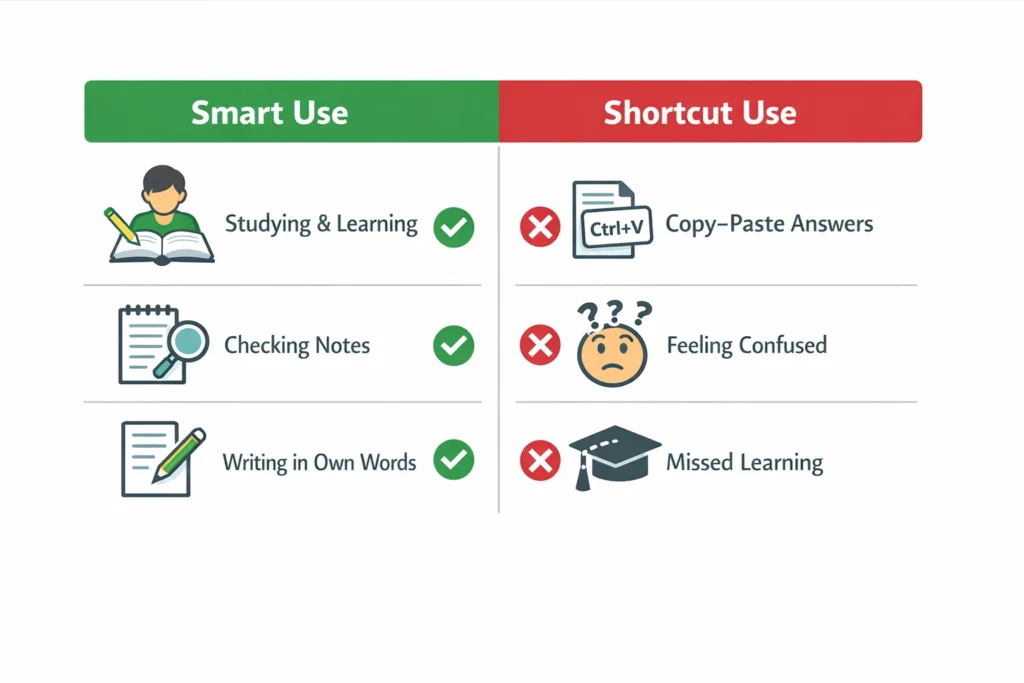
Responsible use is what separates a smart study habit from a shortcut. Students can use AI homework tools effectively without harming learning.
Start with your own attempt
Before asking AI, spend a few minutes trying the question yourself. Even a rough attempt helps. You’ll ask better questions and understand the explanation faster.
This also keeps your brain engaged in the process.
Ask for explanations, not just answers
The best prompts ask for steps, reasons, and examples. For example:
- “Explain this in simple terms”
- “Show the steps”
- “Why is this answer correct?”
- “Give one example and one non-example”
These prompts support learning, not just completion.
Check the response against your materials
After getting help, compare the explanation with:
- class notes
- textbook definitions
- teacher examples
- assignment instructions
This step helps catch errors and keeps your work aligned with the course.
Rewrite in your own words
Even if the AI explanation is useful, students should write the final answer in their own language. This improves memory and reduces the risk of submitting generic work.
It also helps during tests because students remember what they personally wrote.
Use AI for practice, not only homework completion
Students who get the most value use AI for:
- revision quizzes
- concept checks
- sample questions
- study plans
- topic summaries
That turns AI into a learning tool instead of just a homework tool.
Responsible use is simple: think first, ask clearly, verify facts, and write your own final work.
How to Choose the Right AI Homework Helper
Not every AI homework helper fits every student. Some tools are better for math steps. Some are better for writing support. Some feel easy to use, while others are too complex for beginners.
Look for clear explanations
The best homework tools explain ideas in plain language. A tool that gives a perfect-looking answer without explanation is less useful for real learning.
Students need to understand the “why,” not just the result.
Check subject support
A student may need one tool for writing and another for problem-solving. Before choosing a tool, check whether it supports the subjects you study most.
If you use the tool across subjects, consistency becomes easier.
Test ease of use
A good AI homework helper should feel simple. Students should be able to ask questions quickly and get readable responses. If the interface feels confusing, the tool adds friction instead of removing it.
Compare free vs paid plans
Many tools offer free versions with limits. That may be enough for light use. Students who use AI daily may prefer paid plans for better features, more responses, or faster access.
Start with free access if possible. Upgrade only if the tool actually improves your study routine.
Prioritize learning features
Helpful features often include:
- step-by-step explanations
- summary support
- quiz generation
- writing feedback
- follow-up question support
These features matter more than flashy design.
The right AI homework helper is the one that helps you learn clearly and consistently, not the one that only gives fast outputs.
Conclusion
An AI homework helper can be a useful part of modern study, especially when homework feels confusing or overwhelming. These tools help students understand topics, break down tasks, and practice more effectively.
The key is how students use them. AI works best as support, not a replacement for effort. Students who ask for explanations, verify details, and write their own answers usually learn more and perform better.
Used the right way, an AI homework helper saves time, reduces stress, and helps students build stronger study habits.
FAQs
What is an AI homework helper in simple words?
An AI homework helper is a digital tool that helps students understand homework, explain topics, and practice better. It works like a study assistant.
Can an AI homework helper solve homework questions?
Yes, many AI tools can solve homework questions, but students should use them for explanations and learning, not just copying answers.
Is using an AI homework helper cheating?
Using AI for explanations, summaries, and practice is usually a study aid. Copying AI answers and submitting them as your own work may break school rules.
Which students benefit most from AI homework tools?
Students who need help with understanding, writing clarity, time planning, or revision often benefit the most from AI homework helpers.
Can AI homework helpers help with exam prep too?
Yes. Students can use AI to make quizzes, flashcards, summaries, and study plans for exam revision.

Zahid Ali focuses on reviewing AI tools, marketing software, and funnel systems. His reviews break down real-world use cases, setup difficulty, pricing structures, and who each product is best suited for.