
If you’ve ever felt like marketing moves faster than you can keep up, you’re not imagining it. New platforms appear, algorithms shift, customer behavior changes, and suddenly the playbook you relied on last year feels outdated. That’s exactly where AI marketing enters the conversation—not as a magic button, but as a practical way to do better work with less guesswork.
So, what is AI marketing and why it matters? In plain terms, AI marketing is the use of artificial intelligence to help you plan, create, personalize, automate, and improve marketing activities. It can help you understand your audience, decide what to post, write faster, optimize ads, test ideas, and measure results more accurately. For beginners, the simplest way to think about it is this: AI tools help you spot patterns and make decisions based on data, then help you execute tasks faster—without needing to be a data scientist.
This article is written for absolute beginners who want a simple, practical explanation—no jargon overload, no tech-speak. You’ll learn what AI marketing is, what AI marketing tools actually do, where they help the most, and how to use them in a way that still feels human (because real marketing is still about trust, clarity, and relationships).
What Is AI Marketing?
AI marketing is the use of machine learning, natural language processing, predictive analytics, and automation to support marketing work. That sounds technical, but the real meaning is much simpler: AI can analyze information, learn from outcomes, and assist with decisions or content creation.
In traditional marketing, you often rely on experience, instinct, and manual effort. You write copy from scratch, design campaigns based on assumptions, and look at reports after the fact. In AI marketing, you can ask AI tools to help you generate ideas, segment audiences, identify what’s likely to perform well, and automate repetitive work—so you spend more time on strategy and less time on busy tasks.
It’s important to separate “AI marketing” from “marketing about AI.” AI marketing means using AI to do marketing better. You can apply it whether you sell furniture, run a local service business, manage a blog, or build a brand on social media. The benefit isn’t limited to large corporations. In fact, small teams often benefit the most because AI marketing tools act like an extra pair of hands.
Why AI Marketing Matters Right Now?
AI marketing matters because attention is expensive, and time is limited. Brands compete not only against other brands but against entertainment, news, and everyday digital noise. Even if you have a great product, you still need messaging that lands, targeting that reaches the right people, and consistent execution.
AI makes that reality more manageable in three ways.
First, AI can help you move faster. Marketing is full of tasks that take hours: drafting emails, writing product descriptions, creating captions, brainstorming hooks, generating ad variations, summarizing customer feedback, or planning content calendars. AI tools can shorten that time dramatically while still giving you something you can refine into your own voice.
Second, AI can help you reduce wasted effort. Many marketing problems are not about doing more; they’re about doing the right things. AI can help you understand which content themes are resonating, which keywords are gaining traction, what customers are asking, and where people drop off in your funnel. That insight helps you focus.
Third, AI can help you personalize at scale. Personalization used to mean writing one-off messages manually. AI marketing tools can adapt content for different audience segments, different stages of the buyer journey, and different channels—without duplicating all the work. That’s a big reason ai marketing and why it matters has become such a popular conversation: customers expect relevance, and relevance is hard to deliver manually.
What AI Marketing Tools Actually Do?
When beginners hear “AI,” they often imagine robots taking over everything. In reality, most AI marketing tools work like assistants. They help you do your job better by speeding up the parts that are slow, repetitive, or hard to analyze.
Here are the main categories of what AI marketing tools typically help with—explained simply.
1) Content support (writing and editing)
Many marketers start here because it’s the most obvious. AI tools can generate drafts for blog posts, ad copy, email sequences, landing page sections, product descriptions, video scripts, and social captions. They can also rewrite content to match different tones or make it clearer.
The key is that AI is best at the first 60–80%: it gives you options, structure, and momentum. Your job is to make the content accurate, specific, and aligned with your brand. When you use AI this way, it doesn’t replace creativity—it removes blank-page friction.
2) Idea generation and planning
Staying consistent is often harder than being talented. AI marketing tools can help you brainstorm angles, hooks, headline variations, content series ideas, and post formats. They can also help build content calendars based on your niche and audience.
This matters because consistency is a marketing advantage. The teams that win are often the ones who publish steadily and learn quickly, not the ones who produce a “perfect” campaign once every few months.
3) Customer insights and segmentation
AI tools can analyze large amounts of information: reviews, survey responses, chat logs, support tickets, competitor messaging, and social comments. The goal isn’t just to “read faster.” It’s to spot patterns: what people complain about, what they love, what words they use, and what objections show up repeatedly.
That’s extremely valuable because marketing improves when it mirrors the customer’s real language. When your copy sounds like the customer’s own thoughts, it feels persuasive without being pushy.
4) Predictive analytics and performance optimization
Some AI marketing tools help you interpret performance data and forecast outcomes. For example, predicting which leads are most likely to convert, suggesting which products to recommend, or helping decide how to allocate ad budget.
For beginners, you don’t need to understand the math. What matters is the outcome: better decisions with less trial-and-error.
5) Automation and workflows
Automation isn’t new, but AI makes automation smarter. Instead of “if user clicks X, send email Y,” you can use AI-driven systems that adapt messaging based on behavior, timing, and engagement signals.
This is where AI marketing becomes truly scalable. You can maintain a personal feel while handling more customers, more content, and more touchpoints.
AI Marketing vs Traditional Marketing: What Actually Changes?
A helpful way to understand what is AI marketing and why it matters is to compare the workflow.
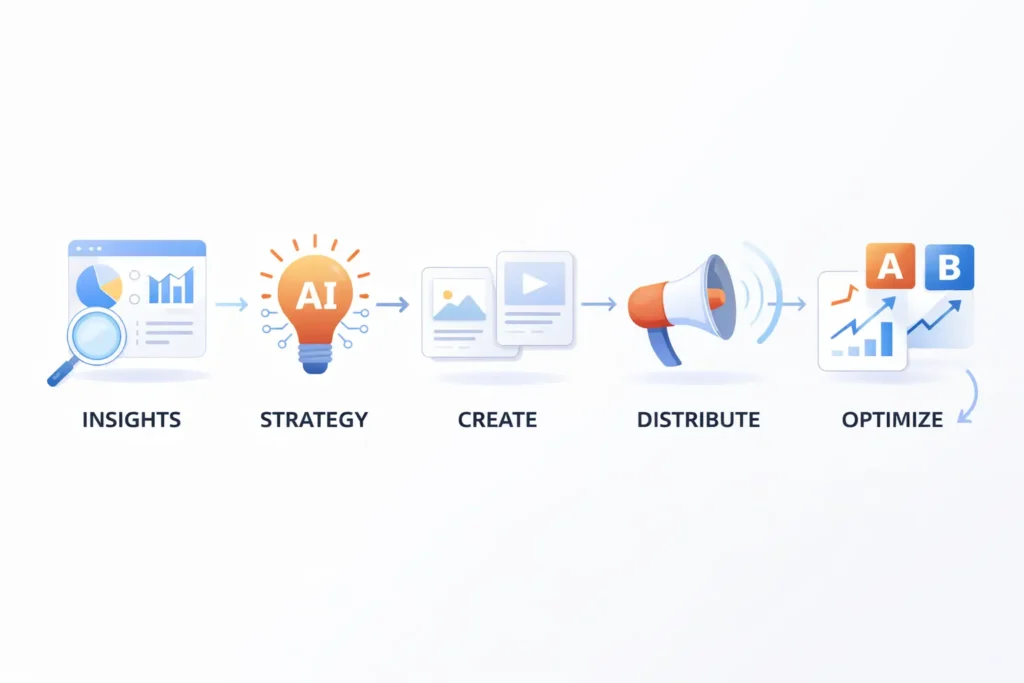
In traditional marketing, you might do this: brainstorm → write → publish → wait → review results → adjust. The cycle is slow, and you may learn weeks later what worked.
In AI marketing, the cycle becomes faster and more iterative: brainstorm with AI → create multiple variations quickly → test smaller experiments → measure sooner → refine and scale what works.
The biggest change isn’t that AI “creates marketing.” The biggest change is that AI makes marketing feel more like a feedback-driven system. You get more shots on goal and learn faster.
The second big change is that marketing becomes less about “one perfect piece” and more about “continuous improvement.” AI tools make it easier to test different angles and messages, which is essential because audiences are diverse. What connects with one segment may fail with another, and AI helps you adapt faster.
Where AI Helps Most in Marketing
A lot of people ask how AI helps in a practical way. Here are everyday scenarios where AI marketing tools tend to shine—especially if you’re just getting started.
If you’re building a blog or niche site, AI can help you outline articles, suggest headings, generate first drafts, and create meta descriptions. It can also help repurpose one article into multiple posts or email summaries. This is useful because consistent publishing is difficult when you’re doing everything alone.
If you run ads, AI can help you produce several headline and description variations quickly, adapt copy for different audiences, and summarize what’s working across campaigns. It won’t magically “make ads profitable,” but it will reduce the time you spend on iterations.
If you manage social media, AI can help generate content themes, write captions in your voice, and turn long-form content into short posts. It can also help you maintain consistency without burning out.
If you run email marketing, AI can help you create welcome sequences, product launch emails, abandoned cart sequences, and follow-ups. The best use is to have AI draft the structure and variations, then you refine with your brand voice and real customer details.
If you sell products, AI can help write product descriptions that highlight benefits, summarize reviews into key selling points, and generate FAQ-style content for product pages.
These are all examples of how ai tools and ai marketing tools work in real situations: they accelerate the production cycle, improve clarity, and help you tailor content for different people.
What AI Marketing Is NOT (Important for Beginners)
AI marketing is powerful, but beginners often run into frustration because of unrealistic expectations. So it helps to be clear about what AI marketing is not.
AI marketing is not a “set and forget” shortcut. If you publish generic content without refining it, you’ll struggle to stand out. AI is a tool, not a brand. Your differentiation still needs to come from your positioning, your real insights, your product quality, and your connection to the audience.
AI marketing is not guaranteed accuracy. AI tools can produce mistakes, outdated claims, or confident-sounding nonsense if you don’t guide them well. That’s why human review matters—especially for anything factual, technical, medical, or legal.
AI marketing is not the same as “spam at scale.” In fact, AI can make spam worse if used carelessly. Real AI marketing focuses on helpfulness and relevance. If AI increases output but decreases trust, it’s not helping your business.
This is also why “why it matters” is such a key phrase: the goal is not more content. The goal is better marketing outcomes—stronger messaging, faster testing, clearer positioning, and smarter personalization.
How AI Marketing Works (Without the Tech Headache)
You don’t need to understand machine learning to use AI marketing tools effectively, but it’s helpful to understand the general idea.
Most AI marketing tools learn from patterns in data. That data might include text (like articles and captions), user behavior (like clicks and purchases), campaign performance metrics (like conversion rates), or customer feedback (like reviews and surveys). The AI uses those patterns to make suggestions or generate content based on prompts.
When you use AI for writing, it’s predicting the next best words based on patterns it learned. When you use AI for optimization, it’s identifying relationships between actions and outcomes. When you use AI for segmentation, it’s grouping people based on similarities.
The simplest way to think about it is: AI doesn’t “understand” like a person. It recognizes patterns and generates useful outputs—often impressively—but it needs your guidance and your judgment.
The Real Benefits of AI Marketing (Beyond Speed)
Speed is the obvious benefit, but not the most important one. The deeper benefits often show up after you use AI marketing consistently.
One of the biggest benefits is better decision-making. When you have tools that can summarize feedback, compare competitors, and highlight themes, you start making choices based on evidence rather than assumptions. That improves everything: messaging, offers, and content strategy.
Another benefit is creative range. Many marketers get stuck repeating the same angles. AI can help you explore different hooks and perspectives you might not consider, which expands your ability to connect with different audience types.
AI also improves consistency. It’s easier to show up regularly when the drafting process is faster. Consistency builds momentum, and momentum builds results.
Finally, AI helps you repurpose content more effectively. Instead of writing everything from scratch for every channel, you can create one strong core asset and adapt it across email, social, blog, and ads. That kind of efficiency is a competitive advantage.
A Simple Way to Start Using AI Marketing (Without Overwhelm)
If you’re new and you’re thinking, “Okay, but where do I start?” here’s a simple approach: start with one small workflow, not ten tools at once.
Pick a single marketing task you do every week. For example, writing social captions, drafting a newsletter, outlining blog posts, or brainstorming content ideas. Use AI to create a draft and then refine it yourself. After two weeks, evaluate if it saved time and improved quality. Then add one more workflow.
AI marketing works best when it becomes a repeatable system. You’re not “trying AI.” You’re building a process where AI supports your execution and you bring strategy and judgment.
A practical mindset is: let AI do the heavy lifting, and you do the finishing work that makes it real—examples, stories, data, product details, and brand voice.
How AI Marketing Fits Into a Simple Marketing Funnel
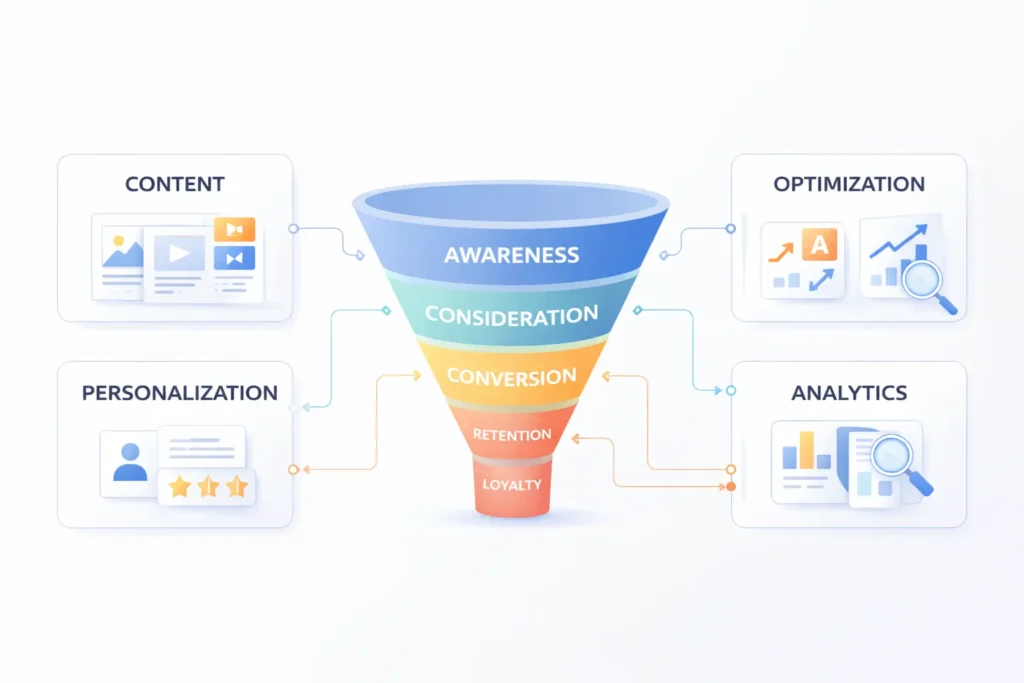
A lot of confusion disappears when you place AI marketing tools inside a basic funnel. You don’t need a complicated framework. Most marketing, no matter the industry, follows the same path: get attention, build trust, create desire, and make it easy to take action. AI can support each step without turning your brand into something cold or robotic.
At the top of the funnel, AI marketing helps you understand what your audience cares about and what they’re searching for. You can use AI tools to brainstorm content topics, write engaging hooks, and create variations of headlines that match different intents. This is where beginners usually see fast wins because attention-based content (blogs, social posts, short videos, lead magnets) benefits from volume and testing. When you can generate several angles quickly, you learn which ones actually connect.
In the middle of the funnel, AI marketing tools shine in personalization and nurturing. This is the stage where people are interested but not ready. AI can help you craft email sequences, create comparison content, answer common objections, and rewrite explanations in simpler language. Many brands lose sales here because they assume customers “get it,” but customers often need clarity, reassurance, and proof. AI can help you create those supporting assets faster.
At the bottom of the funnel, AI can help you improve conversion points like landing pages, product pages, checkout messages, and retargeting ads. It can also help analyze why people drop off. This matters because small changes at the bottom can produce bigger results than huge effort at the top. If AI helps you tighten clarity, improve message-to-market fit, and test variations, the funnel becomes more efficient.
The best part is that none of this requires you to “become an AI person.” If you understand your customer and your offer, AI marketing simply helps you move that understanding into content and campaigns faster.
Common AI Marketing Use Cases That Actually Work
When people ask “what is AI marketing,” they often want concrete examples they can copy. The trick is to choose use cases that create leverage, not just more output. The most reliable use cases are the ones that reduce time, improve clarity, or help you test faster.
One of the strongest use cases is creating content frameworks rather than finished content. For example, you can use AI tools to outline an article, structure an email sequence, or map out a video script. When you start with a solid structure, the final piece becomes easier and more coherent. It also prevents the “AI wrote it” feel, because you’re shaping the content more actively.
Another high-value use case is turning customer language into marketing language. If you collect reviews or comments, AI can summarize the most common pain points and the most common “this is why I bought” reasons. That gives you message gold. You can then write ads and landing pages that reflect what people truly care about, instead of guessing.
AI also helps a lot with “variation work,” which marketing always needs. An ad campaign rarely wins with the first copy version. A blog headline often needs multiple attempts before it feels right. A product page might need a different promise or a clearer benefit. AI marketing tools can create those alternatives quickly, and you choose what matches your voice and strategy.
Finally, AI can support operational consistency. Many marketing plans fail because execution is inconsistent. When AI reduces the effort required to produce drafts, schedules, and reusable templates, consistency becomes realistic—even for one-person teams.
Why AI Marketing Matters for Small Businesses and Solo Creators
It’s easy to assume AI marketing is only for big brands with massive budgets. In reality, small businesses often get the biggest advantage because they’re constrained by time. If you run a business, your marketing is competing with customer service, operations, and daily tasks. Marketing is important, but it’s rarely the only responsibility.
AI marketing tools can change that. They help you produce marketing assets at a pace that would normally require a team. You can create a week of content ideas in minutes, draft emails faster, and generate campaign concepts without hiring multiple specialists. That doesn’t mean the output becomes perfect, but it means you can keep moving.
There’s also a confidence benefit. Beginners often delay marketing because they’re unsure how to phrase things, what to post, or how to structure an article. AI can act like a starter engine. Even if the first draft isn’t ideal, it gives you something to improve, and improvement is easier than invention.
This is a core reason ai marketing and why it matters is a beginner-friendly topic: it reduces the “I don’t know where to start” barrier, which is often the biggest obstacle.
The Human Side of AI Marketing (How to Avoid Sounding Generic)
One of the most common fears is that AI-generated content sounds bland, repetitive, or soulless. That fear is valid—because it happens when AI is used in the laziest way. The good news is you can avoid it with a few simple habits that keep the content grounded in reality and aligned with your voice.
The first habit is adding specifics. AI often produces broad statements. Humans trust details. Instead of saying “AI improves efficiency,” you add a concrete scenario like “turn a two-hour caption-writing session into 20 minutes, then spend the saved time engaging with comments.” Specifics make content feel lived-in.
The second habit is using real examples and your own framing. You don’t need personal stories if you don’t want them, but you should add the type of examples a real marketer would mention—like common objections, real customer questions, or typical mistakes beginners make. AI can draft, but you steer.
The third habit is editing for rhythm and simplicity. AI can write long sentences that feel overly polished. Human writing often varies sentence length, uses natural transitions, and occasionally uses short lines for emphasis. A simple edit pass can change the “texture” of the writing without changing the meaning.
The fourth habit is being careful with claims. AI sometimes sounds confident about results. In marketing, credibility matters. If you can’t prove a claim, soften it. Say “can help” instead of “will,” and focus on practical benefits rather than hype. The more honest the tone, the more human the content reads.
If you apply those habits, AI marketing becomes human-assisted marketing, which is the sweet spot. The tool helps you move faster, but you remain the brain and the brand.
A Simple “Beginner Workflow” You Can Copy
You asked for paragraph-heavy writing with points only where needed, so I’ll keep this light. But one small workflow is worth sharing because it makes AI marketing feel practical.
Start by asking your AI tool to help you define your audience and goal for one piece of content. Then have it generate a few headline options, followed by a rough outline. Next, ask it for two different tones—one friendly and one more direct. Pick the best parts, combine them, and then manually add specifics: real examples, clarifying lines, and your unique viewpoint.
This workflow works for blog posts, landing pages, newsletters, and social posts. The key is that you’re not outsourcing thinking—you’re outsourcing drafting. That’s what makes AI marketing useful, not risky.
The Biggest Mistakes Beginners Make With AI Marketing Tools
AI marketing tools are easy to use, which is both good and dangerous. Beginners often make mistakes that reduce quality and results. Knowing these mistakes helps you avoid frustration.
A common mistake is using AI to create content without a clear purpose. If you don’t know what you want the content to do—inform, build trust, generate leads, sell, or nurture—your content becomes unfocused. AI will happily produce text, but text without intent doesn’t perform. Before you generate anything, decide the goal and the reader’s stage in the journey.
Another mistake is publishing the first draft. AI drafts can be decent, but they often lack originality. If you don’t add examples, structure improvements, and voice edits, your content will blend into the sea of similar articles. The fix is simple: treat AI output like a rough draft, not a finished product.
Another big mistake is relying on AI for facts without checking. Even if you’re writing beginner content, accuracy still matters. If you reference statistics, tool features, or platform rules, verify before publishing. AI marketing is powerful, but trust is more powerful.
Finally, some beginners try too many AI tools at once. They sign up for five platforms, switch between them, and never build a repeatable workflow. It’s better to pick one or two reliable tools and use them consistently for specific tasks.
Does AI Marketing Replace Marketers?
This question comes up constantly, and it’s worth answering clearly. AI marketing does not “replace marketers” in the sense of replacing strategy, customer empathy, positioning, or brand building. Marketing is not just producing content; it’s understanding people, designing offers, and making decisions that shape growth.
What AI does replace is a chunk of repetitive work. It reduces the time required to produce drafts, variations, and basic analysis. That means marketers who use AI well can operate faster and test more ideas. In competitive markets, that speed and iteration can feel like a superpower.
So, the more realistic answer is that AI replaces certain tasks, and it rewards marketers who learn to direct tools effectively. The winners aren’t “AI” or “human.” The winners are humans who can combine strategy with tools.
This is another reason what is ai marketing and why it matters is so important for beginners: it changes what “good marketing” looks like. Creativity still matters, but execution speed and iteration matter more than ever.
Choosing AI Marketing Tools Without Getting Overwhelmed
You don’t need a massive toolkit. The goal is to choose AI tools that match your workflow.
If your biggest bottleneck is writing, look for an AI writing assistant that helps with drafting and rewriting. If your bottleneck is consistency, you may need a planning tool that helps create content calendars and repurposing ideas. If your bottleneck is ads, prioritize tools that generate variations and analyze performance.
A simple way to pick tools is to ask: “Which task do I repeat weekly that I want to do faster without losing quality?” That task becomes your starting point. Once you save time there, you can expand.
Also, be cautious with tools that promise automatic results. Strong AI marketing tools support your decisions; they don’t remove the need for decisions. Any platform that sells “push button marketing” usually leaves out the part where marketing requires clarity, testing, and understanding your customer.
Practical Checklist: Make AI Content Feel Human (Without Extra Work)
You said not to use too many points, so here’s a short checklist you can apply quickly before publishing AI-assisted content:
- Make the opening sound like a real person talking to a real reader, not a textbook.
- Add at least one concrete example in every major section.
- Replace vague promises with clear benefits and realistic language.
- Read it out loud once and smooth anything that sounds overly formal.
- Ensure the content matches your audience’s knowledge level (beginner means simple).
This small step often makes the difference between “generic AI content” and “clean, natural writing that happens to be AI-assisted.”
Final Thoughts: Why AI Marketing Matters (The Real Reason)
AI marketing matters because marketing success is increasingly tied to speed, relevance, and learning loops. The brands that win aren’t always the ones with the biggest budgets; they’re the ones that test faster, understand customers better, and stay consistent. AI tools help you do that without burning out.
If you take one idea from this guide, let it be this: AI marketing is not about replacing your voice. It’s about removing the time-consuming friction so your voice can show up more often, with more clarity, in more places—without losing the human connection that makes marketing work.
Frequently Asked Questions
AI marketing means using AI tools to help you do marketing tasks faster and smarter. These tasks can include writing content, planning campaigns, analyzing audience behavior, personalizing emails, optimizing ads, and improving results based on data. It’s not a replacement for strategy, but it’s a powerful support system.
Because it reduces friction. Beginners often struggle with consistency, ideas, and writing speed. AI marketing tools help you generate drafts, build content plans, and test different messages quickly. That makes it easier to learn what works and improve over time, which is exactly why ai marketing and why it matters is such a valuable beginner topic.
Some are, but many offer free plans or low-cost tiers. The best approach is to start with one tool that solves your biggest bottleneck (writing, planning, ads, or analysis). Once it saves time or improves results, you can decide if upgrading is worth it.
It can—if you publish first drafts without editing. But if you add specifics, adjust tone, and include real examples, AI-assisted content can sound natural and helpful. Treat AI output like a draft, not a final product.
Yes. AI can help generate content ideas, write captions, create variations for different platforms, and repurpose blog posts into short-form content. It can also help you maintain consistency. (This connects closely to your next topic: how AI helps improve social media content.)
AI marketing can support SEO by helping you outline content, improve clarity, generate meta descriptions, and maintain consistent publishing. But it shouldn’t replace real SEO basics like helpful content, good structure, search intent alignment, and accuracy. AI helps execution; SEO still requires strategy.
No. Most modern AI marketing tools are designed for non-technical users. If you can write prompts, choose between options, and edit drafts, you can use AI effectively. The main “skill” is knowing what your audience needs and guiding the tool toward that.
Start with one workflow. For example: generate a blog outline, draft the article, then edit it into your brand voice. Or generate a week of social captions, then refine. Build confidence with one repeatable process before adding more.
It can be. Ethical AI marketing means being honest, avoiding misinformation, protecting customer data, and not using AI to manipulate or spam people. AI should help you communicate better, not trick people into clicking or buying.

Zahid Ali focuses on reviewing AI tools, marketing software, and funnel systems. His reviews break down real-world use cases, setup difficulty, pricing structures, and who each product is best suited for.