
A lot of beginners hear the term sales funnel and assume it means something technical, expensive, or built for big companies.
That is why the topic feels confusing at first. You may see marketers talk about landing pages, email sequences, lead magnets, upsells, and automation as if everyone already understands the system. If you are new, that language can make the whole idea sound harder than it is.
The truth is much simpler.
A sales funnel beginner guide should start with one basic idea: a sales funnel is the path people take before they buy. That path often starts with attention. Then it moves through interest, trust, decision, and action. Some people drop off early. Others keep moving until they become customers.
You already see sales funnels everywhere, even if nobody calls them that. A person clicks a social media post, visits a page, joins an email list, reads a few messages, and then buys a product. That is a funnel. A person watches a YouTube video, clicks a link, reads a review, and places an order. That is also a funnel.
Once you understand the structure, the term stops feeling intimidating. It becomes a practical way to think about how people move from stranger to buyer. That shift matters because it helps you stop guessing. Instead of hoping people buy right away, you start building a better path for them.
What Is a Sales Funnel in Simple Terms?
A sales funnel is a step-by-step journey that moves people toward a purchase.
The word “funnel” comes from the shape. A lot of people may enter at the top, but fewer make it to the bottom. That does not mean the system is broken. That is how buying works in real life. Not everyone who notices a product wants it. Not everyone who wants it is ready today. Not everyone who is interested will trust the offer enough to buy.
A funnel helps organize that process.
Think of a small local bakery. A person sees a post about fresh cakes. Then that person visits the bakery page, checks photos, reads customer comments, and later places an order. That path is a simple sales funnel. The business first earned attention, then built interest, then created enough trust for a sale.
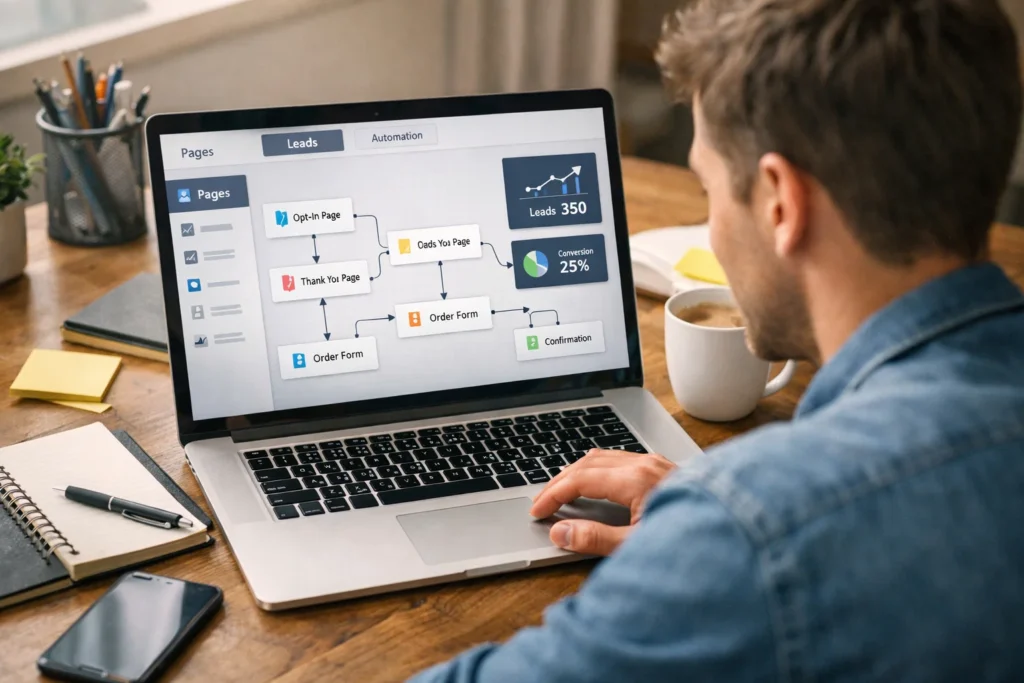
Online, the same pattern happens with more tools. A funnel might use an ad, a landing page, an email form, a product page, and a checkout page. But the core idea stays the same. The funnel guides people from first contact to final action.
This is why sales funnels matter. Most people do not buy the first time they see something. They need a reason to pay attention. Then they need a reason to trust. Then they need a reason to act.
A sales funnel gives structure to those steps.
Why the Sales Funnel Matters for Beginners
Beginners often try to sell too fast.
That mistake is common because it feels logical. You have a product or service, so you put the offer in front of people and hope they buy. Sometimes that works, especially with high-intent traffic. Most of the time, though, people need more context first.
A funnel solves that problem by matching the way people actually make decisions.
Someone who has never heard of you usually needs a different message than someone who already knows your brand. A first-time visitor may need education. A returning visitor may need proof. A warm lead may just need a clear offer and a small push.
Without a funnel, all those people get treated the same. That weakens results.
For beginners, a funnel also makes marketing feel more manageable. Instead of trying to fix everything at once, you can look at each stage separately. Are you getting enough attention? Are people clicking? Are they joining your list? Are they buying? That clarity helps you improve the right part.
Another benefit is that funnels reduce wasted effort. If people are dropping off before checkout, the problem may not be the product. The issue may be trust, messaging, or a weak page. A funnel helps you see those gaps more clearly.
That is why a sales funnel is not just for advanced marketers. It is useful for anyone who wants a clearer path from traffic to sales.
The Main Stages of a Sales Funnel
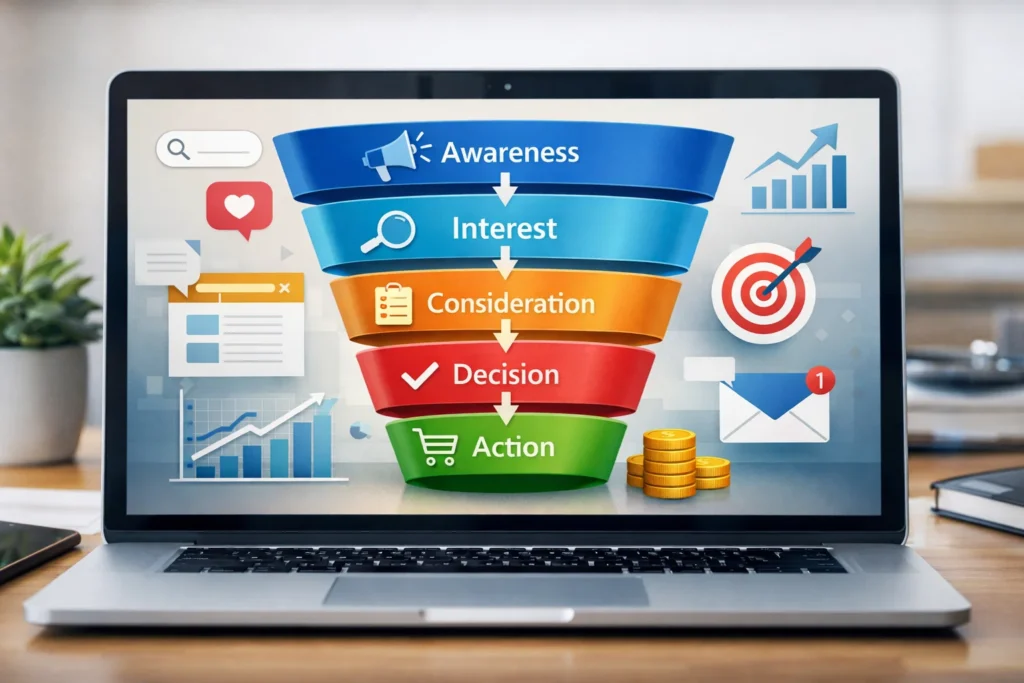
Most funnels follow the same broad structure. The names can change, but the logic stays close.
Awareness
This is the top of the funnel. People first discover you here.
They might find you through search, social media, YouTube, paid ads, referrals, blog posts, or word of mouth. At this stage, the goal is not usually to force a sale. The goal is to get noticed by the right people.
Awareness matters because no funnel works without traffic. If nobody enters the funnel, nothing else can happen.
Interest
Now the person is paying attention.
Maybe that person clicks your page, reads your content, watches a video, or browses your offer. The person is not ready to buy yet, but the curiosity is real. This stage is where your content, message, and presentation begin to matter more.
Your job here is to keep attention and make the next step easy.
Consideration
At this point, the person starts thinking seriously about the offer.
This stage often includes reading product details, checking reviews, comparing options, joining an email list, or asking questions. Trust becomes a bigger factor now. A good funnel usually gives people enough information to feel safe moving forward.
Decision
The person is close to buying.
A good decision-stage funnel often uses a strong offer, clear benefits, social proof, pricing clarity, guarantees, or limited-time reasons to act. The message should feel direct and simple here. Too much friction can push the person away.
Action
This is the sale, signup, booking, or other goal you want.
Action does not always mean a product purchase. In some funnels, the goal may be a lead form, consultation call, free trial, or app install. What matters is that the person takes the step you designed the funnel to support.
These stages help you understand where people are, and what they need next.
How a Sales Funnel Works Step by Step
The easiest way to understand a funnel is to watch a simple example from start to finish.
Imagine someone selling an online course about freelance writing.
First, the person posts helpful short tips on social media. That content attracts beginners who want writing clients. A few people click through to a free guide called “5 Mistakes New Freelance Writers Make.” To get the guide, they enter an email address.
That is the start of the funnel.
Next, the new subscriber receives a few emails. One explains how beginners struggle to find clients. Another shares a success story. A third introduces the course as a structured solution. The subscriber clicks the course page, reads the details, sees testimonials, and decides to buy.
That is a working funnel.
The key point is that the sale did not happen in one jump. The person first got attention, then offered value, then built trust, then made the offer.
A basic funnel often includes these pieces:
- traffic source
- landing page or content page
- lead capture or direct offer
- follow-up content or emails
- sales page or checkout step
Not every funnel needs every part. Some short funnels work with only a video, a landing page, and a checkout page. Other funnels use longer nurturing before the sale. The right structure depends on the product, price, and audience readiness.
Still, the core process is the same. A funnel guides people through a series of small decisions instead of demanding one big decision too early.
Sales Funnel vs Marketing Funnel: Is There a Difference?
People often use these terms as if they mean the same thing. In casual use, that is usually fine. Still, there is a small difference worth understanding.
A marketing funnel often refers to the broader process of attracting and warming up potential customers. A sales funnel usually focuses more on moving interested people toward the sale itself.
In practice, the two overlap a lot.
For example, a blog post that attracts search traffic is often part of the marketing funnel. An email sequence that introduces the product sits closer to the sales funnel. A landing page that collects leads can belong to both.
Beginners do not need to stress over the label too much. What matters is understanding the flow. People discover you, learn about the offer, build trust, and then decide whether to buy.
That entire journey is what most people mean when they talk about funnels.
So if you see both terms, do not get stuck. Focus on the structure, not the wording.
Common Types of Sales Funnels Beginners Should Know
Not every funnel looks the same. Different goals call for different setups.
Lead generation funnel
This type tries to collect contact details, usually an email address.
A free guide, checklist, webinar, discount code, or quiz often works as the entry point. After the lead comes in, follow-up messages help move the person closer to the sale. This funnel works well when buyers need more time before making a decision.
Direct sales funnel
This funnel sends traffic straight to an offer.
A person clicks an ad, lands on a sales page, and then buys or leaves. This works best when the product is simple, the price is lower, or the traffic already has buying intent.
Webinar funnel
This funnel uses a webinar or live presentation to educate and sell.
It is common for coaching, software, consulting, or high-value training products. The webinar builds trust and handles objections before the offer appears.
Application funnel
This type is often used for services, coaching, agencies, or high-ticket offers.
Instead of buying right away, the person fills out a form or books a call. The goal is not instant checkout. The goal is to qualify leads and move the right people into a conversation.
Ecommerce funnel
This funnel usually starts with product discovery and moves toward checkout.
It may include product pages, cart reminders, email recovery, discounts, reviews, and post-purchase offers. The main goal is to reduce drop-off at each shopping stage.
Beginners do not need to use every funnel type. A simple direct or lead generation funnel is often the best starting point.
The Key Parts That Make a Funnel Convert Better
A funnel is not only about having pages and links. A funnel works better when certain pieces are strong.
A clear traffic source
You need the right people entering the funnel.
If your traffic is too broad or low-quality, even a good funnel may struggle. A targeted audience makes everything easier because the message fits better from the start.
A strong offer
People move through funnels faster when the offer feels clear and worthwhile.
This does not always mean cheaper. It means easier to understand. What do they get? Why does it matter? Why should they choose this option?
A focused landing page
A landing page should guide attention in one direction.
Too many links, mixed messages, or unclear copy can lower conversions. Strong landing pages usually have one main goal and one clear next step.
Trust signals
People need reasons to believe you.
Testimonials, reviews, guarantees, case studies, product details, brand clarity, or simple honest copy can all help. Trust is often the difference between interest and action.
Simple follow-up
Many people leave without acting the first time.
Follow-up emails, retargeting ads, reminder messages, or helpful content can bring them back. This is one reason email marketing works so well inside a funnel.
Low friction
Every extra step can reduce conversions.
If the page loads slowly, the form asks too much, or checkout feels confusing, people leave. Simple funnels often perform better because they remove friction.
When beginners improve these parts, funnel performance usually improves too.
A Simple Sales Funnel Example for Beginners
Let’s use a plain example that feels realistic.
Imagine you sell a beginner fitness ebook.
You create short social media videos about common workout mistakes. At the end of the video, you mention a free checklist: “7 Beginner Workout Mistakes to Avoid.” People click the link in your bio and land on a page offering the checklist in exchange for an email address.
After signup, the person gets the checklist right away. Then a short email sequence begins. One email explains why beginners lose motivation. Another shares a basic weekly workout structure. Then you introduce the paid ebook as the next step for people who want a full plan.
That is a beginner-friendly sales funnel.
Here is the flow:
- social media video brings attention
- free checklist captures the lead
- email sequence builds trust
- ebook offer turns warm leads into buyers
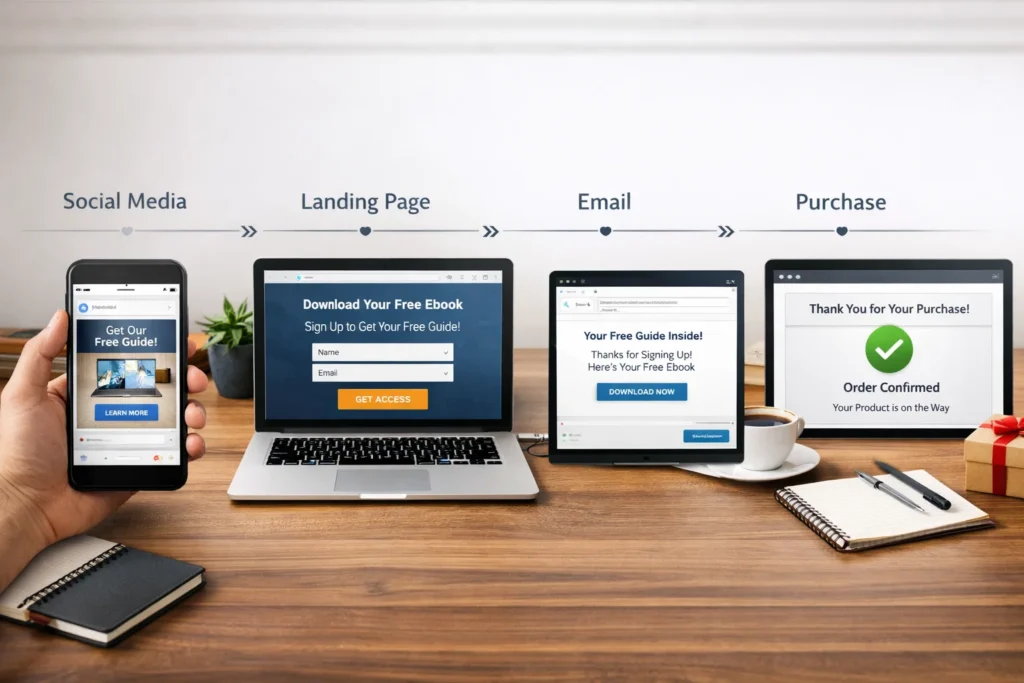
This works because each step feels natural. The free resource matches the audience problem. The follow-up keeps the message relevant. The paid offer feels like a next step, not a random sales push.
That is what a good funnel does. It creates a smoother path.
Mistakes Beginners Often Make With Sales Funnels
Beginners usually do not fail because funnels are too complex. They fail because the basics are skipped.
One common mistake is sending cold traffic straight to a weak sales page. If people do not know you yet, they may need more trust before buying.
Another mistake is using too many steps too early. A beginner sees advanced funnel diagrams and tries to build ten pages, three offers, two upsells, and a long automation setup. That often creates confusion, not growth.
Weak offers also hurt funnels. If the offer feels vague, boring, or poorly matched to the audience, no page design can save it.
Here are a few common beginner mistakes:
- choosing the wrong audience
- making the offer unclear
- using messy landing pages
- asking for too much information
- skipping follow-up emails
- sending mixed messages at different stages
- trying to sell before building trust
Another problem is impatience. Funnels need testing. If one page underperforms, that does not mean the whole model is broken. It may just mean the headline, offer, or traffic source needs work.
Beginners usually do better when they build a simple funnel first, then improve it step by step.
How to Build a Simple Sales Funnel as a Beginner
You do not need complicated software or a huge budget to get started.
A basic funnel can begin with one traffic source, one landing page, one offer, and one follow-up path. That is enough to learn the system.
Here is a practical starting process.
Step 1: Choose one clear audience
Start with a specific group of people. Broad audiences make funnels harder to write.
Step 2: Pick one clear problem
The funnel should solve one obvious need. Clarity helps every stage.
Step 3: Create one entry point
This could be a blog post, short video, ad, social post, or search result.
Step 4: Offer one next step
That next step could be a free download, a product page, a booking form, or a free trial.
Step 5: Build one page for that action
Make the message simple. Keep distractions low. Use one main call to action.
Step 6: Add follow-up
If you collect leads, send a short helpful email sequence. If you sell directly, consider reminder emails or retargeting.
Step 7: Test and improve
Watch where people drop off. Then improve one part at a time.
A simple funnel is often the best teacher. Once you see how people move through it, the whole concept becomes easier to manage.
How to Know If Your Funnel Is Working
A funnel is working when people move through the steps at a reasonable rate.
That does not mean every visitor buys. Funnels always lose some people along the way. The question is whether enough of the right people keep moving forward.
You can measure this by checking each stage.
Are people clicking from your traffic source? Are they joining your list or visiting the offer page? Are they opening emails? Are they buying? These numbers show where the biggest problem sits.
For example, if people click but do not sign up, the landing page may be weak. If they sign up but never buy, the follow-up or offer may need work. If nobody clicks at all, the traffic source or message may be the real issue.
Useful funnel questions include:
- Are the right people entering the funnel?
- Does the landing page make the next step clear?
- Does the offer feel valuable enough?
- Are trust signals strong enough?
- Is follow-up happening at the right time?
You do not need perfect data at the start. Even simple tracking can help you spot obvious leaks.
That is the advantage of thinking in funnel stages. Problems become easier to diagnose.
Conclusion
Understanding what is a sales funnel becomes much easier once you stop thinking of it as a technical marketing trick. A funnel is simply a structured path that helps people move from attention to action.
That is why funnels matter.
They give your marketing direction. They help you match the message to the moment. They also make it easier to see where people lose interest and where trust needs to be built. For beginners, that clarity can save time, reduce confusion, and improve results faster than random promotion.
Start simple. One audience, one offer, one path. Then improve each step as you learn. That is how a sales funnel beginner guide turns from theory into something useful in real work.
FAQs
What is a sales funnel in simple words?
A sales funnel is the path people follow before they buy. It moves them from first contact to final action through a series of steps.
Why is it called a funnel?
It is called a funnel because many people enter at the top, but fewer continue to the bottom where the sale happens.
Do small businesses need a sales funnel?
Yes. Small businesses benefit from funnels because they help turn visitors into leads or customers in a more organized way.
Can I build a sales funnel without email marketing?
Yes. Some funnels sell directly without email. Still, email often helps because many people need follow-up before buying.
What is the simplest sales funnel for a beginner?
A simple beginner funnel could be one traffic source, one landing page, one offer, and one short follow-up sequence.