
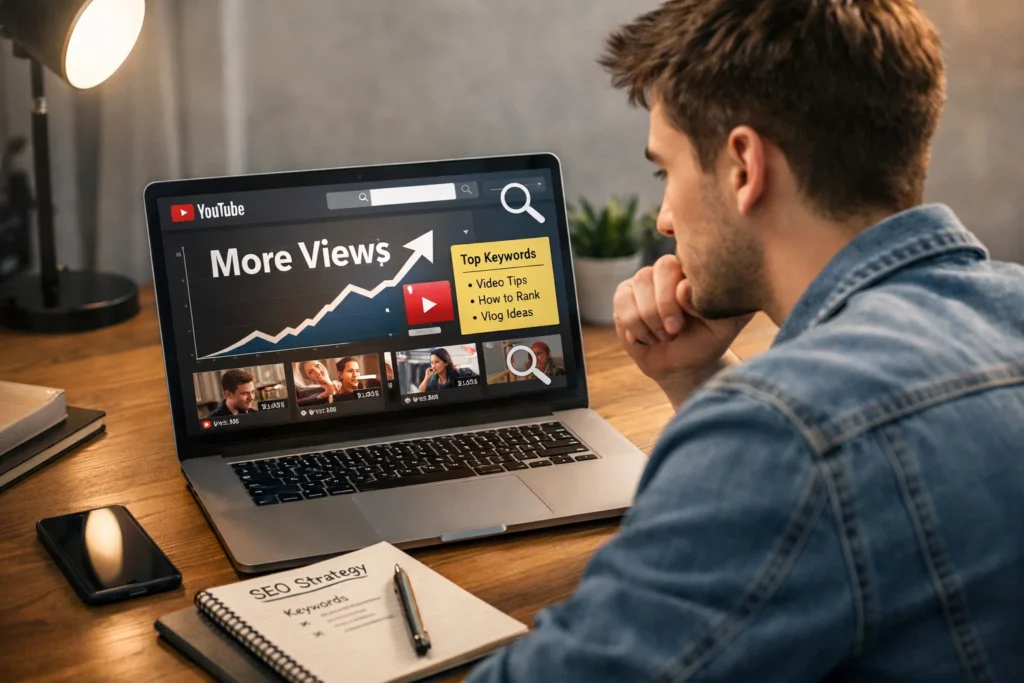
Why do some videos get views while yours stay buried, even when the content is useful?
That question frustrates almost every new creator. You spend time planning, recording, editing, and uploading. Then the video sits there. A few clicks come in, but growth never starts. Many beginners assume the problem is the algorithm. In most cases, the real issue is simpler. The video does not send clear signals to YouTube.
That is where YouTube SEO helps.
How beginners can use YouTube SEO to get more views is not a mystery. You do not need expensive tools. You do not need a huge audience either. You need a clear topic, the right keywords, stronger titles, better viewer signals, and a simple publishing habit that makes your channel easier to understand.
YouTube wants to show videos people are likely to watch and enjoy. That means your job is not only to upload a good video. Your job is to help YouTube understand what the video is about, who should see it, and why viewers should keep watching.
What YouTube SEO Really Means
YouTube SEO is the process of making your video easier to find and easier to recommend.
A lot of beginners think SEO only means adding keywords to a title. Keywords do matter, but YouTube SEO goes much further than that. YouTube looks at your topic, your title, your description, your click-through rate, your watch time, your audience response, and how well the video matches what a viewer wanted.
Search matters on YouTube. So do suggested videos, home page recommendations, and topic-based discovery. A video can grow from more than one source. That is why strong YouTube SEO is not about stuffing words into your upload. It is about building a clear package around a useful video.
Think of it this way. Your video has two jobs. First, it must attract the right click. Second, it must keep the right viewer watching. If either part breaks, growth slows down.
That is also why many channels struggle. A weak title gets ignored. A confusing thumbnail gets skipped. A slow opening loses viewers fast. Or the topic itself is too broad. All of those issues affect SEO because YouTube sees the results in viewer behavior.
For beginners, this is good news. You do not need to master every feature at once. You only need to improve the signals that matter most.
Start With Search Intent, Not Just Keywords
Before you write a title, ask one question: what is the viewer trying to find?
This matters more than people think. A keyword shows what someone typed. Search intent shows what that person actually wants. Those two things are close, but not always the same.
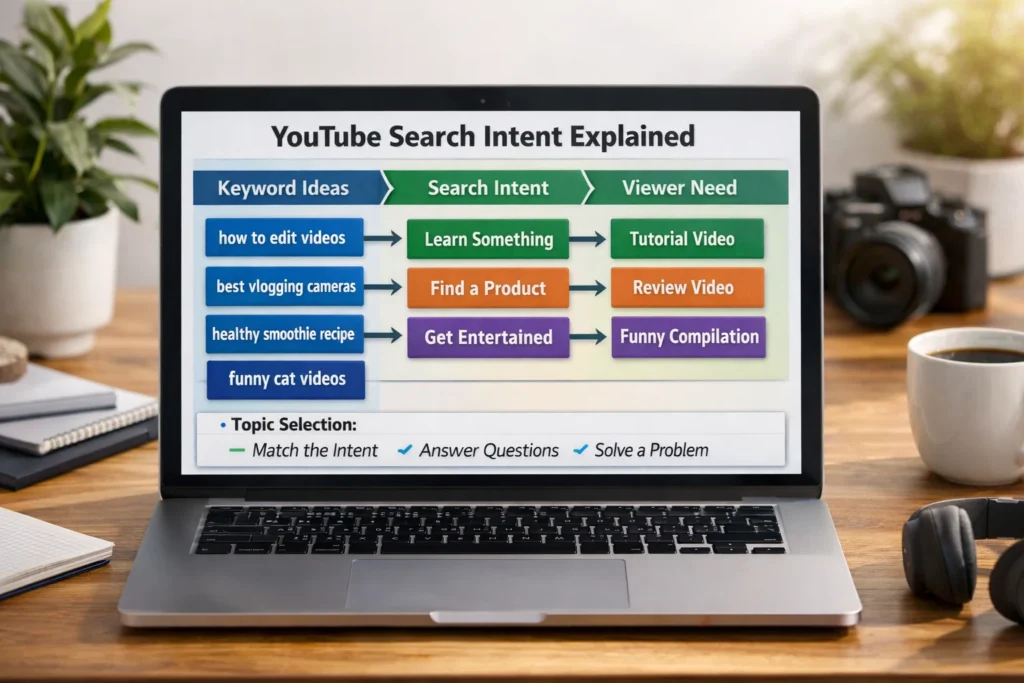
For example, someone searching “YouTube SEO for beginners” usually wants a simple explanation. That person does not want an advanced lecture about analytics. Someone searching “how to rank YouTube videos” may want steps they can follow today. Someone searching “why my YouTube videos get no views” may be looking for a fix.
When you match that intent, your video becomes easier to click and easier to watch. Viewers feel understood. YouTube notices that response.
Here is a simple way to think about search intent:
- Learn something: tutorials, beginner guides, step-by-step videos
- Fix a problem: troubleshooting, mistakes, reasons, solutions
- Compare options: tool reviews, strategy comparisons, this vs that
- Get results: tips, hacks, action plans, checklists
A beginner often makes one of two mistakes. The first is chasing broad keywords that are too competitive. The second is choosing vague topics that nobody searches for clearly. A better path sits in the middle. Pick a topic with real demand, but narrow the angle.
Instead of “YouTube growth,” make the video “How to write YouTube titles that get more clicks.” Instead of “SEO tips,” make the video “YouTube SEO basics for new channels.”
That shift makes your content more focused. Focus makes SEO easier.
Find Beginner-Friendly Keywords You Can Actually Use
Keyword research does not need to be complicated. You can find useful phrases with free methods and a little attention.
Start with YouTube search itself. Type your main topic into the search bar and watch the suggestions. Those suggestions often reflect real search behavior. They can help you spot phrases viewers already use.
Then look at the videos ranking for those phrases. Study the wording in titles, thumbnails, and video angles. Do not copy them. Just notice patterns. Are top videos aimed at beginners? Are they short and direct? Are they framed as tutorials, mistakes, or simple guides?
You can also check Google search if your topic overlaps with search-based content. Some YouTube videos rank in Google too, especially for tutorials, reviews, and how-to content.
When picking keywords, beginners should favor phrases that are:
- clear
- specific
- easy to match with one video
- realistic for a smaller channel
Good beginner keyword choices often include words like “beginner,” “simple,” “step by step,” “how to,” “tips,” or “mistakes.” These phrases usually reflect practical intent.
Here is the part many new creators skip: use one main keyword, then build around closely related phrases. Do not try to target ten different ideas in one upload. A single clear topic usually performs better than a scattered one.
For this article’s topic, a video could naturally include related phrases like YouTube SEO tips, rank videos on YouTube, get more views on YouTube, YouTube titles, YouTube keywords, video descriptions, and watch time. These fit because they support the same main idea.
That is how keyword use should feel. Natural, connected, and useful.
Build Titles That Earn Clicks Without Feeling Cheap
A title can make or break your video before anyone watches a second.
Many beginners either write titles that are too plain or titles that promise too much. Neither helps. A plain title gets ignored. An overhyped title may get clicks, but viewers leave when the video does not match the promise.
A strong title does three things at once. It tells the topic, shows the benefit, and creates a reason to click.
Look at the difference:
Weak: YouTube SEO Tips
Better: How Beginners Can Use YouTube SEO to Get More Views
The stronger title makes the audience clear. It also states the result. A beginner instantly knows whether the video fits.
Useful title patterns include:
- How to get a specific result
- Beginner guide to a clear topic
- Common mistakes that hurt results
- Simple steps for solving one problem
- What works now for a defined audience
Keep your wording tight. Front-load the main phrase when possible. Place the most important words early, because mobile viewers may not see the full title.
You should also make sure the title matches the video. If the title promises “5 ways,” the video should deliver five clear ways. If the title says “for beginners,” the explanation should stay simple. Matching expectation improves retention, which helps SEO.
Do not force keywords where they sound awkward. A human-sounding title usually performs better than a robotic one.
Use Thumbnails as Part of SEO, Not Just Design
A thumbnail is not only a design choice. It affects clicks, and clicks affect how often YouTube keeps showing the video.
That is why thumbnails and SEO work together. A good thumbnail helps the right viewer notice the video fast. A weak one gets buried, even when the topic is strong.
Beginners often make thumbnails too busy. Tiny text, too many elements, weak contrast, and unclear focus all reduce clicks. Most viewers scan quickly. Your thumbnail should make sense in a second or two.
A stronger thumbnail usually has one clear idea. That might be a facial expression, a short phrase, a bold visual contrast, or an obvious before-and-after angle. Simplicity helps.
Here are a few thumbnail principles that work well for new creators:
- Focus on one main visual idea
- Use short, readable text only if needed
- Make the subject stand out clearly
- Match the promise of the title
- Keep a consistent style across your channel
The title and thumbnail should work together, not repeat each other word for word. If the title explains the topic, the thumbnail can create emotion or curiosity. If the thumbnail states a result, the title can explain how.
For example, a title might say, “How Beginners Can Use YouTube SEO to Get More Views.” The thumbnail might say, “More Views, Less Guessing.” That pairing feels connected without being repetitive.
Better clicks from the right audience can improve your video’s early performance. That gives the video a stronger chance to keep moving.
Write Descriptions and Video Metadata With a Clear Purpose
Descriptions still matter, but not in the old, stuffed-keyword way.
A beginner does not need to write a long wall of text. A better approach is to write a clear description that supports the video topic and helps YouTube understand the content.
Put the main topic near the beginning. Mention the core benefit in natural language. Then expand a little with related phrases if they fit the video. Keep the wording readable. If a real viewer would find the description awkward, rewrite it.
A simple description structure works well:
- State what the video covers
- Mention who it helps
- Add supporting details or related points
- Include useful links if needed
Tags matter less than they once did, but they can still help with context in some cases. Use them lightly. Focus more on the title, thumbnail, description, spoken content, and viewer response.
Your file name before upload does not carry major weight, so do not obsess over it. Captions, though, are more useful. Clear spoken language and accurate captions can help YouTube understand your content better. They also make the video more accessible.
Chapters can help too, especially in educational videos. Good chapters improve the viewing experience and make the structure clearer.
The main goal is simple: make every part of the upload support the same topic.
Keep People Watching, Because Retention Supports SEO
YouTube SEO is not only about getting found. It is also about keeping attention.
That is where retention comes in. Retention shows how much of the video people watch. If viewers click and leave fast, YouTube gets a poor signal. If viewers stay, the video gains strength.
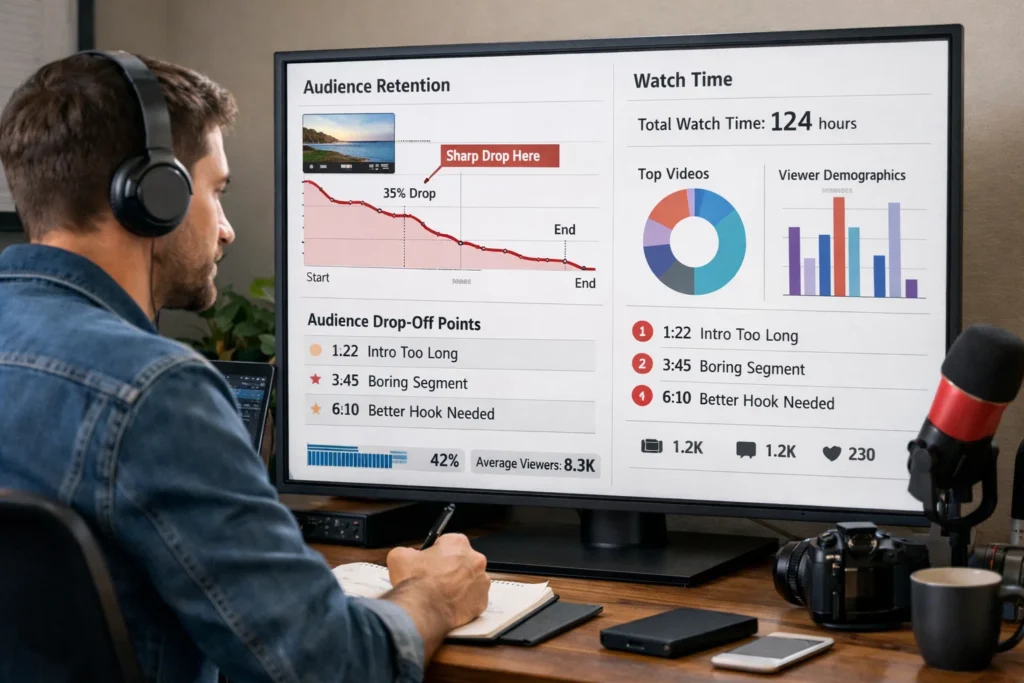
Many beginners lose viewers in the first 15 to 30 seconds. The opening is often too slow, too generic, or too self-focused. Long intros, logo animations, and off-topic chatter hurt momentum.
A better opening gets to the point early. Tell viewers what they will learn. Show the problem clearly. Give them a reason to stay.
For example, instead of saying, “Hey guys, welcome back to my channel,” start with the problem: “If your videos get almost no views, weak YouTube SEO may be the reason.” That line gives people context fast.
To improve retention:
- Start with the problem or promise
- Cut long intros
- Follow a clear structure
- Remove repeated ideas
- Keep pacing steady
- Use visual changes when helpful
- End sections cleanly and move forward
Retention also improves when the video matches the title. Misleading packaging may earn the click, but it rarely keeps the viewer. That hurts performance later.
Beginners sometimes chase tricks. Most of the time, the real fix is better clarity. A clear topic, strong opening, useful content, and clean structure often outperform flashy editing.
Make Your Video Easy for YouTube to Understand
YouTube has to interpret your video before recommending it well. That is why clarity matters so much.
A scattered video makes this harder. If the title says one thing, the introduction says another, and the content drifts into side topics, YouTube gets mixed signals. Viewers do too.
A focused video gives YouTube more confidence. The title, thumbnail, spoken words, description, and chapters all point in the same direction. That alignment improves discoverability.
Say the main topic naturally in the video. If the video teaches YouTube SEO for beginners, speak that idea early. Explain the problem in plain words. Use related phrases where they fit. This is not about repeating keywords in a forced way. It is about topical consistency.
Here is a simple alignment check before you publish:
- Does the title reflect the actual video?
- Does the thumbnail support the same angle?
- Does the first minute confirm the promise?
- Does the description match the topic clearly?
- Does the video stay on that topic throughout?
If the answer is yes, you are already ahead of many new creators.
Use Playlists, Internal Traffic, and Channel Structure Wisely
A single video matters, but your channel structure matters too.
YouTube wants to understand your channel themes. If your uploads feel random, growth often slows. If your channel has clear topic clusters, your content becomes easier to recommend across videos.
This is why playlists help. A good playlist groups related content and encourages longer sessions. Longer session time can support channel growth because viewers stay within your content longer.
Let’s say you create videos about YouTube growth. Instead of mixing random topics, build small content paths. One playlist could cover YouTube SEO basics. Another could cover thumbnails and titles. Another could cover beginner mistakes.
This creates a stronger viewer journey.
You should also use internal traffic smartly. Mention related videos during the current video when the fit feels natural. Add end screens and cards where helpful. Link relevant videos in the description and pinned comment.
This does two things. First, it gives viewers another useful step. Second, it teaches YouTube how your content connects.
For beginners, channel structure often gets ignored because the focus stays on each new upload. That is understandable. Still, a small amount of planning goes a long way.
Study Your Data Without Getting Lost in It
Analytics can help, but beginners often overcomplicate them.
You do not need to check every graph each day. Start with a few useful signals. Look at which videos get impressions, which titles get clicks, where viewers leave, and what traffic sources bring views.
Those numbers tell a story.
If impressions are low, YouTube may not understand the video yet, or the topic may have weak demand. If impressions are decent but clicks are low, the title and thumbnail may need work. If clicks are strong but watch time is weak, the content or opening may not match the promise.
This is where patient improvement matters. One underperforming video does not prove failure. YouTube often needs time to test content. Also, not every topic behaves the same way.
A simple beginner review process works well:
- Check click-through rate
- Check average view duration
- Check audience retention curve
- Check traffic sources
- Compare top videos for patterns
Try to learn one lesson from each upload. That is enough. You do not need a perfect system. You need steady feedback and small improvements.
Stay Consistent Long Enough to Let SEO Work
Many beginners quit too early.
That is one of the hardest parts of YouTube. SEO does not always pay off fast. Some videos pick up slowly. Others take off after weeks or months. A new channel often needs time before YouTube fully understands what audience fits best.
Consistency helps because it creates more data, more chances to rank, and a clearer channel identity.
That does not mean uploading every day. It means following a pace you can maintain. One solid video each week is better than a burst of uploads followed by silence.
Consistency also helps you improve faster. The more videos you make, the easier it becomes to spot patterns in topics, hooks, thumbnails, and viewer behavior.
Try to think in batches, not isolated uploads. What are the next five videos around the same audience problem? What beginner questions keep coming up? Which topics naturally connect?
That mindset builds momentum. It also makes your SEO stronger because your channel starts to feel more coherent.
A lot of beginners search for one trick that changes everything. In reality, growth usually comes from a group of simple habits repeated well.
Common YouTube SEO Mistakes Beginners Should Avoid
New creators often make the same mistakes. The good part is that most of them are fixable.
One common mistake is targeting topics that are too broad. Another is using titles that are accurate but dull. Many beginners also spend too much time on small details while ignoring retention and topic clarity.
A few mistakes show up often:
- choosing a topic without checking viewer intent
- using vague titles
- making cluttered thumbnails
- opening the video too slowly
- covering too many ideas in one upload
- ignoring playlists and related videos
- quitting before enough data builds
Another mistake is copying bigger channels too closely. Large creators can rank with broader topics because they already have trust and momentum. A smaller channel usually grows faster by being more specific.
The goal is not to look bigger than you are. The goal is to become easier to understand and easier to choose.
Conclusion
Learning how beginners can use YouTube SEO to get more views does not require a complicated system. The basics still do most of the work. Choose a focused topic. Match search intent. Use clear keywords. Write better titles. Design cleaner thumbnails. Keep viewers watching. Build related content around the same audience.
That is the real foundation.
You do not need to master every part this week. Start by improving one video at a time. A clearer title, a stronger opening, or a more focused topic can make a real difference. Over time, those small upgrades stack up, and your channel becomes easier for viewers and YouTube to trust.
FAQs
How long does YouTube SEO take to work?
It depends on the topic, competition, and channel history. Some videos get traction in days. Others take weeks or longer. Beginners should think in months, not hours.
Do small channels need YouTube SEO?
Yes. Small channels may need YouTube SEO even more because they have less built-in traffic. Clear topics, titles, and retention can help YouTube test the content faster.
Are tags still important on YouTube?
Tags are not the main ranking factor. They can add some context, but titles, thumbnails, topic clarity, watch time, and viewer response matter more.
Should I use the exact keyword in the title?
Use the main keyword if it fits naturally. Do not force awkward phrasing. A clear human title usually works better than a stiff keyword-heavy one.
What matters more, search or recommendations?
Both matter, but many channels grow more from recommendations over time. Search can help people discover your content first, while recommendations can expand reach later.