
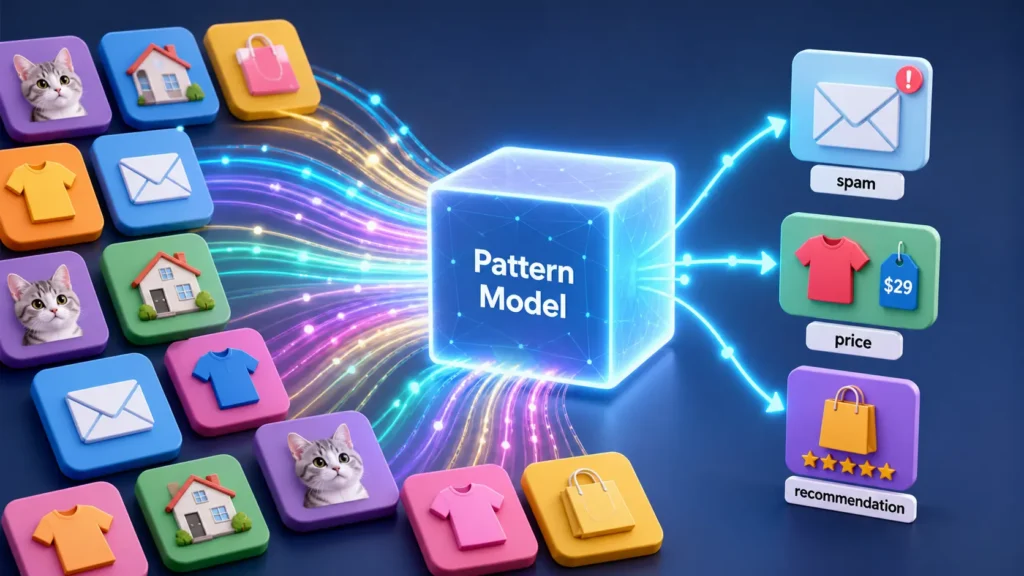
Machine learning is a way for computers to learn patterns from data. Instead of giving the computer every rule by hand, people give the computer examples. The computer studies those examples and learns how to make predictions or decisions.
That may sound strange, but humans learn in a similar way.
A child does not need a full science book to recognize a cat. The child sees many cats, hears the word “cat,” and starts noticing patterns. Cats often have whiskers, tails, ears, and certain shapes. After enough examples, the child can recognize a new cat.
Machine learning works in a similar direction, but with data instead of human experience.
This guide explains machine learning in plain English. You’ll learn what machine learning means, how machine learning works, where people use machine learning, and why the topic matters for total beginners.
What Is Machine Learning?
Machine learning is a type of computer technology that learns from examples.
A normal computer program follows fixed instructions. A person writes the rules. The computer follows them step by step. If the rules do not cover a situation, the program may fail.
Machine learning works differently.
With machine learning, people feed data into a system. The system looks for patterns in that data. Then the system uses those patterns to make a prediction, classify something, or suggest an action.
For example, an email spam filter does not need one fixed rule for every scam email. The filter can study many old spam emails. Then the filter learns common patterns, such as strange links, suspicious wording, and unusual sender behavior.
After training, the filter can judge new emails. The filter may say, “This message looks like spam,” even if nobody wrote a rule for that exact email.
That is the core idea.
Machine learning does not mean a computer thinks like a person. The computer does not understand the world like humans do. The computer finds patterns in data and applies those patterns to new cases.
That simple point clears up many myths.
Why Machine Learning Matters for Total Beginners
Machine learning matters because the technology now appears in everyday life.
You may not notice machine learning directly. But you likely use systems powered by machine learning each day. Search results, product recommendations, voice assistants, maps, shopping apps, video feeds, fraud alerts, and photo tools often use machine learning in some form.
A beginner does not need to become a programmer to understand the basic idea. Basic knowledge helps you use modern tools with more confidence.
Machine learning also affects jobs, business, marketing, education, healthcare, finance, and entertainment. The more digital systems grow, the more these systems depend on data.
That does not mean every machine learning system is perfect. Far from it. These systems can make mistakes. They can learn from biased data. They can give poor results when the input data is weak.
Still, machine learning has become important because it helps computers handle tasks that are hard to program with simple rules.
A person can write a rule like, “If a password is shorter than eight characters, reject it.” That rule is simple.
But writing every rule for speech recognition, fraud detection, image tagging, or language translation is much harder. Machine learning helps with those complex tasks.
How Machine Learning Works in Simple Terms
Machine learning usually follows a basic path.
First, people collect data. Then they train a model with that data. After training, the model can make predictions on new data. People then check the results and improve the system.
Let’s break that down.
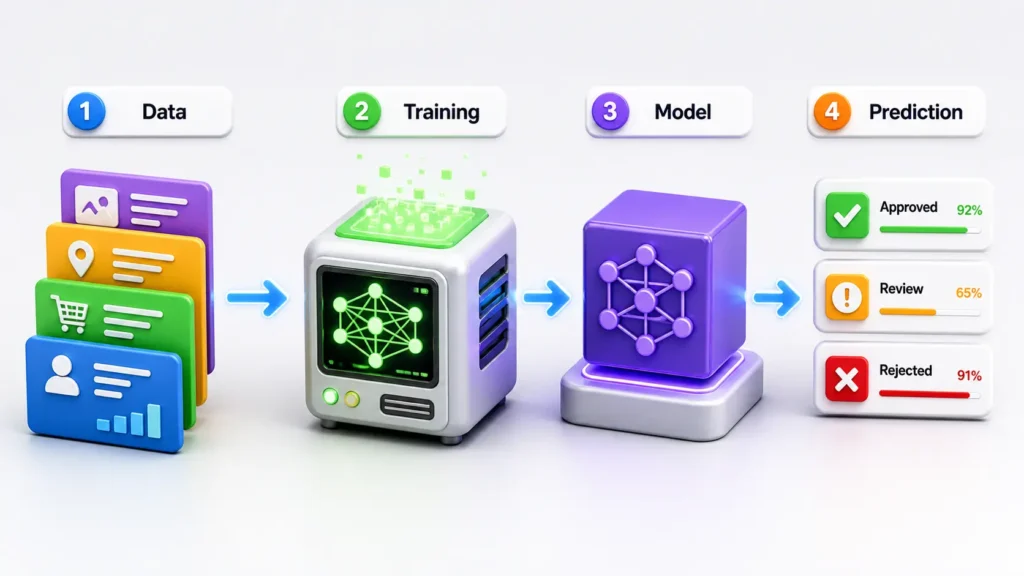
Data gives the system examples
Data is the starting point.
Data can include numbers, words, images, sounds, clicks, purchases, ratings, locations, or many other signals. The type of data depends on the problem.
For example, a weather model may use temperature, wind speed, pressure, and past weather records. A music app may use listening history, skipped songs, liked songs, and playlists.
The machine learning system learns from this data.
Good data matters a lot. If the data is messy, outdated, limited, or unfair, the model may learn poor patterns. That is why data quality is such a big part of machine learning.
The model learns patterns
A model is the part of the system that learns from data.
Think of the model as a pattern-finder. During training, the model studies examples and adjusts itself. The goal is to make better predictions over time.
For example, a model may study thousands of house sales. The data may include location, size, number of rooms, age, and sale price. Over time, the model learns which details often affect price.
Then the model can estimate the price of a new house.
The model does not “know” houses like a real estate expert. The model only uses patterns from past data.
Training improves the model
Training is the learning stage.
During training, the model makes guesses. Then the system checks those guesses against known answers. When the guess is wrong, the model adjusts. After many examples, the model can improve.
A simple example helps.
Imagine you show a model many photos labeled “dog” and “not dog.” At first, the model may make many mistakes. With enough labeled examples, the model starts learning visual patterns linked to dogs.
The model may notice shapes, fur textures, ears, noses, and body outlines. Later, the model can look at a new photo and predict whether the photo shows a dog.
Testing checks real performance
After training, people test the model on data the model has not seen before.
This step matters because a model can memorize training examples without learning well. A good model should perform well on new examples, not only old ones.
Testing helps answer a simple question:
“Can this model handle real cases?”
If the model performs poorly, people may need better data, a different model, or more careful training.
A Simple Real-Life Example of Machine Learning
Let’s use a simple example: predicting whether a customer may cancel a subscription.
A company may have data about past customers. The data could include account age, login frequency, support tickets, plan type, payment history, and past cancellations.
A machine learning model studies this data. The model looks for patterns among customers who canceled.
Maybe customers who stop logging in are more likely to cancel. Maybe customers with many support tickets are also at higher risk. Maybe customers who use certain features often are less likely to leave.
After training, the model can review current customers. Then the model can estimate which customers may cancel soon.
The company can use that prediction to help people earlier. For example, the company may send helpful onboarding emails or ask if support is needed.
This example shows the basic purpose of machine learning. The model studies the past to make useful guesses about the future.
The same idea appears in many places.
A bank may predict fraud. A store may predict what products people may buy. A streaming app may predict what videos people may watch. A search engine may predict which result best answers a query.
Different examples, same basic idea.
Machine Learning vs Artificial Intelligence
Many beginners confuse machine learning and artificial intelligence. That confusion makes sense because people often use both terms together.
Artificial intelligence, or AI, is the larger idea. AI means creating computer systems that can perform tasks that seem smart. These tasks may include understanding language, recognizing images, planning routes, or making recommendations.
Machine learning is one way to build AI systems.
So, machine learning sits inside the bigger AI field.
A simple way to think about the difference:
- Artificial intelligence is the broad goal of making machines act smart.
- Machine learning is a method that helps machines learn from data.
- Deep learning is a more advanced type of machine learning.
Not every AI system uses machine learning. Older AI systems sometimes used hand-written rules. For example, a rule-based chatbot might answer questions based on fixed scripts.
Modern AI tools often use machine learning because data-based learning handles many complex tasks better.
This does not make machine learning magic. The system still depends on data, design, testing, and human goals.
Common Types of Machine Learning
Machine learning has several types. Beginners do not need deep technical detail. But knowing the main categories helps.
Supervised learning
Supervised learning uses examples with known answers.
The model learns from data that already has labels. For example, an email may be labeled “spam” or “not spam.” A photo may be labeled “cat” or “dog.” A house record may include the final sale price.
The model studies the examples and learns how inputs connect to answers.
Supervised learning is common because many business problems have past data with known outcomes.
Examples include:
- Predicting house prices
- Detecting spam emails
- Classifying support tickets
- Predicting customer churn
- Recognizing objects in images
Supervised learning works best when you have enough accurate labeled data.
Unsupervised learning
Unsupervised learning uses examples without known answers.
The model looks for hidden patterns or groups in the data. Nobody tells the model the “right” label for each example.
For example, a store may use unsupervised learning to group customers by shopping behavior. One group may buy budget items. Another group may buy premium products. Another group may only buy during sales.
The model finds these groups from patterns.
Unsupervised learning can help with customer segmentation, data exploration, recommendation systems, and anomaly detection.
Reinforcement learning
Reinforcement learning works through rewards and penalties.
The system tries actions and learns from results. Good actions earn rewards. Bad actions receive penalties. Over time, the system learns which actions lead to better outcomes.
This type appears in game-playing systems, robotics, and some control systems.
A simple example is a computer learning to play a game. The system tries moves, loses points, gains points, and improves through practice.
Reinforcement learning can be powerful, but beginners usually meet supervised learning first.
Machine Learning Algorithms in Plain English
An algorithm is a set of steps used to solve a problem.
In machine learning, algorithms help the model learn patterns from data. Different algorithms learn in different ways. Some work better for simple data. Others work better for images, text, or complex relationships.
You do not need to memorize every algorithm as a beginner. But a few plain-English examples help.
Decision trees
A decision tree works like a flowchart.
The model asks a series of questions and follows branches. For example, a loan approval model may ask about income, debt, credit history, and payment behavior.
Each answer moves the decision down a branch. At the end, the tree gives a result.
Decision trees are easy to understand, which makes them useful for beginners.
Linear regression
Linear regression predicts a number.
For example, a model may predict house price from house size. If larger homes often sell for more money, the model can use that relationship to estimate prices.
Real problems may use many inputs, not just one. Still, the basic idea stays simple. The model learns how different factors connect to a number.
Neural networks
Neural networks are models inspired loosely by how brains process signals.
They use layers of connected parts to find patterns. Neural networks can handle images, speech, text, and other complex data. Deep learning uses large neural networks with many layers.
Beginners do not need to know the math right away. Just remember this: neural networks are useful when patterns are complex and data is large.
Where You See Machine Learning in Daily Life
Machine learning is not only for engineers or large tech companies. Many everyday tools use machine learning quietly.
You may see machine learning when:
- Your email app filters spam.
- A shopping site recommends products.
- A map app predicts traffic.
- A bank flags unusual card activity.
- A phone groups photos by faces.
- A streaming app suggests movies.
- A search engine ranks results.
- A voice assistant hears your command.
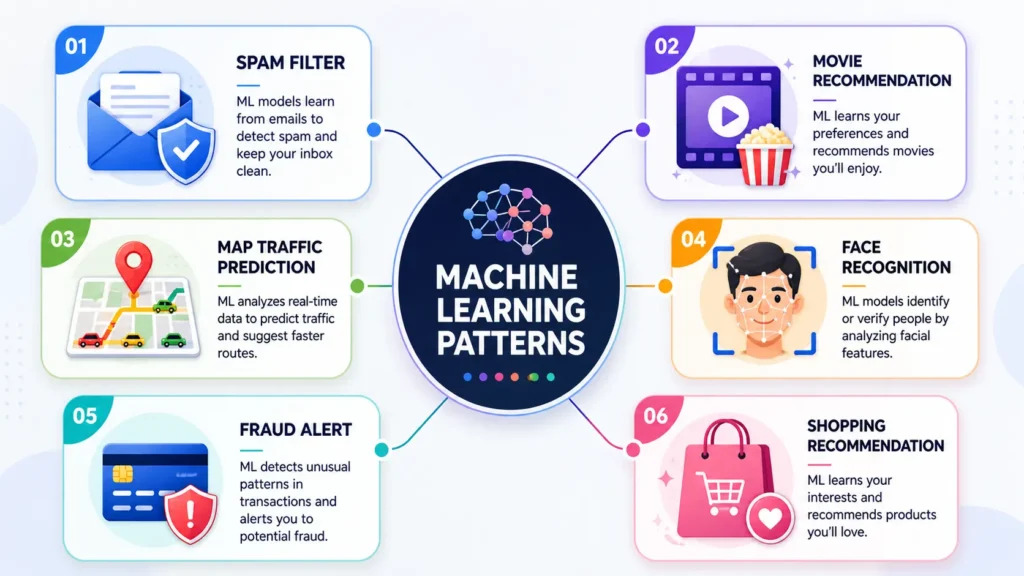
These examples work because the systems learn from past patterns.
A map app can study traffic data and road history. A shopping site can study purchases and browsing behavior. A bank can compare new transactions with normal spending patterns.
Machine learning helps these systems make fast predictions at scale.
Of course, predictions can still be wrong. A recommendation may feel odd. A spam filter may block a real email. A map may choose a poor route. A fraud alert may stop a normal purchase.
Machine learning improves many tasks, but human judgment still matters.
Why Data Matters So Much in Machine Learning
Data shapes what the model learns.
If the data is strong, the model has a better chance. If the data is weak, the model may produce weak results.
Think of a student learning from practice tests. If the practice tests are clear, fair, and close to the real exam, the student can prepare well. If the practice tests are full of errors, the student learns the wrong lessons.
Machine learning works the same way.
A model trained on poor data may learn wrong patterns. A model trained on biased data may make unfair decisions. A model trained on old data may fail when the world changes.
That is why people spend so much time cleaning and checking data.
Data quality can include:
- Accuracy
- Completeness
- Freshness
- Fairness
- Enough examples
- Relevant features
A machine learning model does not automatically know which data is good. People must choose, clean, and review the data carefully.
This is one reason machine learning projects need human oversight.
What Machine Learning Can and Cannot Do
Machine learning can be useful, but beginners should understand the limits.
Machine learning can find patterns in large amounts of data. Machine learning can make predictions faster than humans in many cases. Machine learning can improve tasks that depend on repeated examples.
But machine learning cannot understand everything like a person.
A model may give a confident answer for the wrong reason. A model may fail when new data looks different from training data. A model may repeat bias from old records. A model may not explain its decision clearly.
Machine learning also needs a clear problem.
A vague goal like “make the business better” is too broad. A clearer goal works better, such as “predict which customers may cancel this month” or “classify support emails by topic.”
Machine learning is a tool, not a replacement for clear thinking.
Use machine learning where patterns, data, and predictions matter. Use human judgment where context, ethics, emotion, and complex meaning matter.
Beginner-Friendly Machine Learning Terms
Machine learning has many terms. Some sound more complex than they are.
Here are the basic words beginners should know.
Dataset
A dataset is a collection of data used for training, testing, or analysis.
A dataset might contain customer records, product reviews, images, sales numbers, or medical scans.
Feature
A feature is one useful detail in the data.
For a house price model, features may include size, location, age, and number of rooms.
Label
A label is the known answer used in supervised learning.
For an email model, the label may be “spam” or “not spam.”
Model
A model is the trained system that makes predictions or decisions.
The model learns from data during training.
Training
Training is the process where the model learns patterns from examples.
The model improves by comparing guesses with known answers.
Prediction
A prediction is the model’s output for new data.
For example, the model may predict a price, category, risk level, or next action.
Accuracy
Accuracy measures how often the model gives correct answers.
Accuracy is useful, but not always enough. Some problems need other measures too, especially when mistakes have serious costs.
How Beginners Can Start Learning Machine Learning
You do not need to start with advanced math or complex code.
A better path is to understand the ideas first. Learn what machine learning does. Learn what data means. Learn why models make mistakes. Then move into tools and code when you feel ready.
Start with simple examples. Spam filters, recommendation systems, and house price predictions are easier to understand than advanced research topics.
Then learn basic data skills. Spreadsheets, charts, and simple statistics can help. Machine learning depends on data, so data comfort matters.
After that, you can try beginner-friendly tools or simple Python lessons. Many beginner projects use small datasets and clear goals.
Good starter projects include:
- Predicting house prices
- Classifying emails
- Grouping customers
- Predicting movie ratings
- Recognizing handwritten numbers
Don’t rush. Machine learning has layers. The beginner goal is not to master everything. The beginner goal is to build a clear mental picture.
Once the basic picture makes sense, the technical parts feel less scary.
Common Myths About Machine Learning
Machine learning often gets described in dramatic ways. That can confuse beginners.
Myth 1: Machine learning thinks like a human
Machine learning does not think like a human. A model finds patterns in data. The model does not understand feelings, meaning, or common sense the way people do.
Myth 2: More data always means better results
More data can help, but only when the data is useful. Bad data at a larger scale can create bigger problems. Quality matters as much as quantity.
Myth 3: Machine learning is always correct
Machine learning systems make mistakes. They can misread patterns, fail on new cases, or reflect bias. Testing and review are important.
Myth 4: Only programmers need to understand machine learning
Many non-programmers benefit from understanding machine learning. Business owners, marketers, writers, teachers, managers, and students all use tools shaped by machine learning.
Myth 5: Machine learning replaces human judgment
Machine learning can support decisions. But people still need to define goals, check results, and handle sensitive choices.
Why Machine Learning Will Keep Growing
Machine learning will keep growing because modern life creates large amounts of data.
People search, click, watch, buy, upload, message, and move through digital systems every day. Businesses and tools can use those patterns to improve services, detect problems, and make better predictions.
Machine learning also keeps spreading into smaller tools. Years ago, only large companies could use advanced systems. Now many apps include machine learning features by default.
You can find machine learning in writing tools, photo editors, customer support software, analytics platforms, marketing tools, security systems, and finance apps.
This does not mean every use is good or needed. Some machine learning features are helpful. Some are overbuilt. Some raise privacy or fairness concerns.
That is why basic understanding matters.
When you know how machine learning works, you can ask better questions. What data does the system use? How accurate is the model? What happens when the model is wrong? Who checks the results?
Those questions matter more as machine learning becomes more common.
FAQs About Machine Learning
What is machine learning in simple words?
Machine learning is a way for computers to learn from examples. The computer studies data, finds patterns, and uses those patterns to make predictions or decisions.
Is machine learning the same as AI?
No. Artificial intelligence is the larger field. Machine learning is one method used to build AI systems. Many modern AI tools use machine learning.
Do I need math to understand machine learning?
You do not need advanced math to understand the basic idea. Beginners can start with plain examples and simple concepts. Math becomes more useful when you want to build models yourself.
What is the easiest example of machine learning?
A spam email filter is one of the easiest examples. The filter studies past emails and learns patterns that help identify spam messages.
Can machine learning make mistakes?
Yes. Machine learning can make mistakes when data is poor, biased, outdated, or incomplete. Models also struggle when new situations differ from training examples.
Conclusion
Machine learning may sound complex at first, but the basic idea is simple.
A computer studies examples. The computer learns patterns from those examples. Then the computer uses those patterns to make predictions about new data.
That is the heart of machine learning.
You see machine learning in email filters, search engines, maps, shopping apps, banking alerts, photo tools, and streaming recommendations. These systems help with tasks that are too complex for simple fixed rules.
Still, machine learning is not magic. The results depend on data quality, clear goals, careful testing, and human judgment.

Zahid Ali focuses on reviewing AI tools, marketing software, and funnel systems. His reviews break down real-world use cases, setup difficulty, pricing structures, and who each product is best suited for.